
 India
India

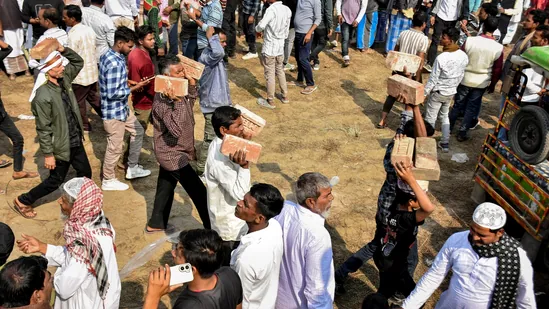
In a fresh and dramatic turn in West Bengal’s escalating temple-versus-mosque political narrative, posters announcing the construction of an Ayodhya-style Ram Temple surfaced across Salt Lake on Thursday. The development comes just days after a Babri Masjid-inspired mosque project was launched in Murshidabad, intensifying the charged political atmosphere months before the state assembly elections.
The posters — attributed to Sanjay Poyra, former BJP local unit president and a prominent party face in Bidhannagar — appeared at key locations such as City Centre, Karunamoyee and several parts of the planned township. Declaring that a Ram temple “similar to the Ayodhya structure” would be built on a four-bigha plot, the posters also urged residents to contribute a symbolic Re 1 as donation toward the project.
This announcement follows a major controversy triggered on December 6 when suspended TMC MLA Humayun Kabir laid the foundation stone for a mosque modelled on the Babri Masjid in Rejinagar, Murshidabad. The date — the anniversary of the 1992 demolition — and the military-level security deployed at the event underscored the political sensitivity surrounding the move. On the same day, the BJP countered by holding its own temple foundation ceremony in Manindra Nagar, also in Murshidabad, accusing Chief Minister Mamata Banerjee of indulging in appeasement politics.
With the Salt Lake development, the political duel has now shifted closer to the administrative heart of the state, giving it deeper symbolic resonance. Speaking to the media, Poyra framed the initiative as part of a “social-spiritual movement” aimed at ushering in Ram Rajya. “Ram’s kingdom must have Ram’s temple. A grand Ram temple will be built in Bidhannagar just like Ayodhya,” he asserted.
However, Poyra declined to reveal the exact location of the proposed land plot. “We have identified the land, but disclosing it now will create obstacles. Many have offered land, construction materials, even idols. This is a people’s movement,” he said.
Poyra further announced that the bhumi pujan and shilanyas ceremony will take place on March 26, coinciding with Ram Navami. “At 10 am on Ram Navami, we will perform the foundation-laying. Sanatanis from all walks of life will join. If people want to donate Re 1, we will welcome it happily,” he added.
The posters also present the proposed temple complex as a model of “service-driven devotion,” claiming it will include a hospital for the poor, a school, women’s education facilities, an old-age home and other welfare services. Organisers say this reflects their version of Ram Rajya, blending spirituality with social responsibility.

The Bidhannagar civic authorities have yet to comment on the sudden appearance of these posters or clarify whether any official request has been made for such a construction — particularly in a regulated township with strict land-use norms.
A senior political observer noted that the sequence of events — a Babri-style mosque announcement, a BJP temple ceremony in Murshidabad and now the Salt Lake temple project — indicates that “both sides are weaponising religious imagery to energise deeply polarised voter groups.”
As the assembly polls draw near, West Bengal seems poised for an intense stretch of competitive symbolism where temples, mosques, and religious narratives take centre stage in the state’s political battle.


 English
 Gujarati
 Hindi
Hindi Kannada
 Malayalam
 Marathi
 Punjabi
 Tamil
Tamil Telugu