


 India
India

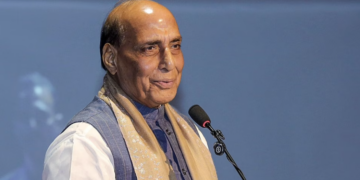
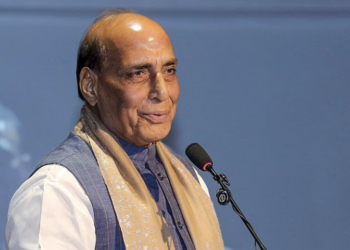
Defence Minister Rajnath Singh on Friday described Operation Sindoor as a landmark in India’s military and strategic thinking, symbolizing a new defence doctrine rooted in “resolve and courage.” Addressing the Army Commanders’ Conference in Jaisalmer, Singh said the operation demonstrated India’s ability to respond to terrorism on its own terms, setting a precedent for future counter-terror responses.
The minister, along with the top brass of the Indian Army, reviewed the security situation along the borders with China and Pakistan and assessed the force’s operational preparedness. He also visited the forward areas of Tanot and Laungewala in Rajasthan, close to the Pakistan border, where he praised the army’s readiness and resilience.
“Operation Sindoor will go down in history not just as a military operation but as a symbol of the nation’s courage and restraint,” Singh said. He added that the Indian Army’s actions reflected policy precision combined with human dignity. The defence minister reaffirmed that India’s mission for peace would continue “as long as even a single terrorist mindset remains alive.”
Launched in May as a retaliation to the Pahalgam terror attack that killed 26 civilians, Operation Sindoor targeted terrorist infrastructure inside Pakistan. The assault, carried out against The Resistance Front—a proxy of the Lashkar-e-Taiba—led to four days of intense hostilities before both sides agreed to cease military actions on May 10.
During his address, Singh urged the army to remain vigilant and never underestimate adversaries. He stressed the need to focus on information warfare, modern defence infrastructure, and the indigenisation of military technology. “Our armed forces must stay technologically advanced, strategically agile, and ethically strong,” he said.
Singh also praised the army’s role in maintaining peace and development in Jammu and Kashmir following the abrogation of Article 370. “Today, the streets there are filled with hope, not unrest,” he said, adding that local governance has strengthened the region’s democratic spirit.
Referring to the situation along the Line of Actual Control (LAC) with China, Singh said India’s policy remains one of “dialogue and readiness.” He acknowledged the ongoing de-escalation talks in Ladakh as a sign of balanced diplomacy, even as both nations continue to maintain roughly 50,000 troops each in the region.

The conference, attended by Chief of Defence Staff Gen Anil Chauhan, Army Chief Gen Upendra Dwivedi, and other senior officials, discussed key areas such as grey-zone warfare, innovation, and jointness among the armed forces. Singh also inaugurated Edge Data Centres for the Konark and Fire & Fury Corps, launched the Sainik Yatri Mitra app, and unveiled the Defence Millet Dishes Compendium compiled by the Army Service Corps Centre and College in Bengaluru.
The defence minister also paid homage at the Laungewala Yudh Sthal, inaugurated the Chandpuri Hall dedicated to Brigadier Kuldip Singh Chandpuri, and felicitated veterans of the 1971 India-Pakistan war. He later witnessed a live “capability demonstration exercise” showcasing new units like the Bhairav Battalion and Ashni Platoon, underscoring the army’s blend of tradition and modernisation.
Singh concluded by reaffirming that India’s armed forces remain “one of the most adaptable in the world,” capable of operating across diverse terrains and evolving warfare domains such as cyberspace and space control.



 English
 Gujarati
 Hindi
Hindi Kannada
 Malayalam
 Marathi
 Punjabi
 Tamil
Tamil Telugu