

 India
India

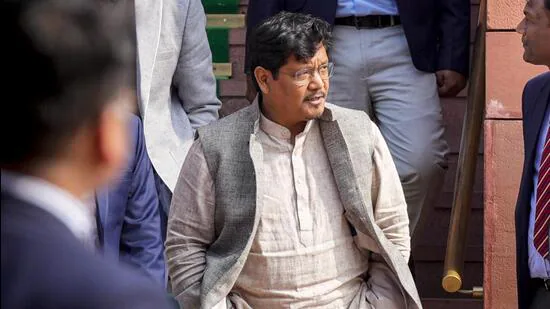
Meghalaya Chief Minister Conrad K Sangma on Thursday announced that his government will revisit and amend the 2016 Meghalaya Residents Safety and Security Act (MRSSA) to address concerns surrounding illegal immigration and ensure the law withstands judicial and central scrutiny.
Replying to a discussion in the state assembly on a resolution moved by Leader of Opposition Mukul Sangma, Conrad said the administration is committed to drafting amendments that will make the law more effective and legally robust. “I assure the House that we will re-examine the entire aspect and see how we could bring amendments in the MRSSA which would withstand the scrutiny of the judiciary as well as of the Government of India and Parliament,” he stated.
The Meghalaya High Court had in December 2021 halted the implementation of certain provisions of MRSSA, citing the lack of authority for the state to regulate entry and exit points along the Bangladesh border. The Union Home Ministry has also asked Meghalaya to review the legislation, prompting the state government to work closely with the Law Department, the Advocate General, and the Home Department to navigate complex legal frameworks.
Conrad emphasized that illegal immigration is often driven by economic opportunities. “They are coming here because of economics; they are getting jobs. At the end of the day, it is only by finding long-term socio-economic solutions and ensuring every stakeholder plays their role that we will be able to find a solution to tackle illegal immigration,” he said.
The government is also exploring validation of entry and exit points under the new Immigration and Foreigners Act, 2025, which includes provisions for restricted areas. While amendments are being drafted, the registration and monitoring provisions of MRSSA will continue to be implemented. To date, 817 localities and 427 sub-localities have been registered, with ongoing efforts to cover over 7,000 villages across the state.
Mukul Sangma later withdrew his resolution in light of the chief minister’s response, praising the administration’s commitment to addressing the issue. “Today’s discussion reflects the collective resolve and intent to improve the sense of responsibility towards this crucial issue,” he said.
Conrad concluded by underlining that while the intent behind MRSSA was positive, the law operates within the constraints of multiple Acts, rules, and constitutional provisions, highlighting the need for a careful, comprehensive approach to secure Meghalaya’s borders while balancing socio-economic realities.




 English
 Gujarati
 Hindi
Hindi Kannada
 Malayalam
 Marathi
 Punjabi
 Tamil
Tamil Telugu