


 India
India

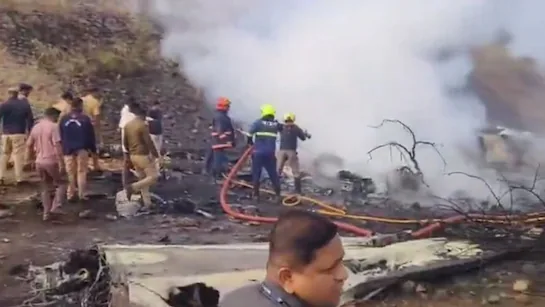

A tragic plane crash near Baramati airport in Maharashtra’s Pune district on Wednesday morning claimed the life of Deputy Chief Minister Ajit Pawar and four others, sending shockwaves across the country and triggering an intense investigation into what caused the fatal accident.
Ajit Pawar was travelling from Mumbai to his hometown Baramati to address four public meetings ahead of the Zilla Parishad elections when the chartered Learjet 45 aircraft crashed during landing at around 8:48 am. The aircraft reportedly made two attempts to land before veering off the runway and bursting into flames.
Those killed in the crash include Ajit Pawar, his personal security officer Vidhit Jadhav, flight attendant Pinki Jadhav, and pilots Sumit Kapur and Shambhavi Pathak. Visuals from the crash site showed extensive wreckage scattered near the runway, highlighting the severity of the impact.
As condolences poured in from political leaders across party lines, questions mounted over the circumstances that led to the crash. Union civil aviation minister K Ram Mohan Naidu said preliminary information suggested that visibility at Baramati airport was poor at the time of landing. He confirmed that the aircraft attempted to land twice before the crash occurred.
Adding critical perspective, former Indian Air Force pilot Ehsan Khalid — who had previously flown with pilot Sumit Kapur during their Sahara Airlines days — said the accident may have resulted from a combination of factors rather than a single cause.
Speaking to ANI, Khalid highlighted the lack of adequate electrical and navigational landing aids at Baramati airport. He noted that under such conditions, actual visibility on the ground could be significantly worse than what is officially reported.
“I have known the pilot for nearly two decades. He was experienced and highly capable. If visibility was completely unsafe, he would not have attempted the landing,” Khalid said, explaining that the situation likely fell under what pilots describe as “marginal visibility.”
He added that marginal visibility creates a difficult “go or no-go” decision for pilots, where weather conditions may appear manageable but can deteriorate rapidly during approach. Khalid also said it remains unclear whether the first missed approach was due solely to weather or if technical issues with the aircraft played a role.
Investigative agencies, including the Directorate General of Civil Aviation (DGCA) and the Aircraft Accident Investigation Bureau (AAIB), have been deployed to determine the exact sequence of events. Flight tracking data shows the aircraft departed Mumbai at 8:10 am and disappeared from radar shortly before the crash. Reports indicate that the pilot had alerted air traffic control about visibility concerns moments before impact.
The BJP-led Maharashtra government has announced three days of state mourning as the probe continues into one of the most shocking aviation tragedies involving a sitting political leader in recent years.




 English
 Gujarati
 Hindi
Hindi Kannada
 Malayalam
 Marathi
 Punjabi
 Tamil
Tamil Telugu