



 India
India

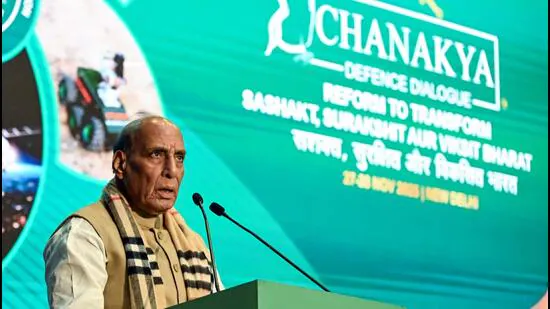
India’s growing economic clout, technological self-confidence and steady foreign policy have made it “a voice of balance and responsibility” in an increasingly fragile world, defence minister Rajnath Singh said on Friday. Addressing the concluding session of the Chanakya Defence Dialogue 2025 in New Delhi, Singh said countries across the Indo-Pacific and the wider Global South now regard India as a reliable partner capable of shaping a more secure, stable and equitable international order.
Singh underlined that India’s internal progress has global consequences. “When India advances on the path of strength, security and development, the world benefits in several ways,” he noted. A stable India, he said, contributes to the resilience of the global economy. Meanwhile, India’s digital public infrastructure has emerged as a global template for transparent and inclusive governance, while its ethical approach to new-age technologies such as AI, cyber tools and space capabilities has set standards that many nations increasingly look to for guidance.
At the event, the minister also unveiled Project Ekam, a strategic initiative aimed at building indigenous artificial intelligence systems tailored specifically for military needs. The defence ministry said the project ensures full control over data security and is designed around Indian military terminology, doctrines and operational requirements. It has already developed a common framework and platform for hosting open-source and indigenous AI models, positioning it as a major technological leap for India’s armed forces.
Singh stressed that India’s growing global influence is rooted in consistency—its commitment to sovereignty, rules-based order and peaceful engagement. But he warned that the increasingly turbulent geopolitical landscape, marked by terrorism, cross-border extremism, unilateral attempts to alter the status quo, maritime pressures and information warfare, demands constant preparedness.
Reforms, he argued, are now a strategic necessity. Modernisation efforts, strengthened institutions and agile armed forces enable India to shape its own destiny rather than be shaped by global events. Echoing this sentiment, President Droupadi Murmu—who addressed the dialogue a day earlier—praised the army for reshaping doctrines and upgrading capabilities to remain mission-ready across all domains.
Singh said reforms have been accompanied by sustained investment in infrastructure and self-reliance. “We are strengthening border and maritime infrastructure to support security and connectivity. We are modernising our forces through new platforms, technologies and structures. We are reforming procurement processes to ensure speed, transparency and accountability,” he said.
At the heart of this transformation is Atmanirbharta, which Singh described as the foundation of a growing domestic defence ecosystem. India is nurturing start-ups, encouraging deep-tech innovation and boosting R&D to prepare for the battlefields of the future. Equally important, he said, is ensuring the welfare of soldiers, veterans and their families.

Calling the armed forces the “strongest pillar of national resilience”, Singh said their readiness, discipline and resolve allow India to manage neighbourhood challenges and contribute to broader regional stability. “India believes in peace and dialogue, but when it comes to sovereignty and security, we do not compromise,” he asserted.
Reforms and modernisation, Singh concluded, are not mere administrative measures—they are investments in India’s long-term strategic future.




 English
 Gujarati
 Hindi
Hindi Kannada
 Malayalam
 Marathi
 Punjabi
 Tamil
Tamil Telugu