

 India
India

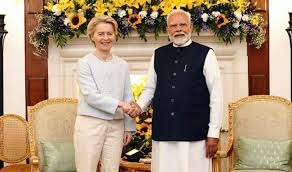
Prime Minister Narendra Modi on Tuesday framed the newly signed India–European Union Free Trade Agreement (FTA) as far more than a commercial pact, projecting it instead as a geopolitical statement at a time of deep global uncertainty and rising protectionism. Speaking after the conclusion of negotiations in New Delhi, Modi said the India-EU partnership would help bring “stability to the world order” amid what he described as mounting international turmoil.
“There is turmoil in the global environment. India and the European Union will provide stability to the world order,” Modi said at a joint press conference alongside European Council President Antonio Costa and European Commission President Ursula von der Leyen. The remarks came soon after the two sides sealed what both described as the largest and most ambitious trade agreement in their histories.
Modi called the pact “a new blueprint for shared prosperity”, stressing that it was not merely about lowering tariffs but about reshaping long-term economic cooperation between two major global blocs. Costa echoed the sentiment, calling the India-EU FTA the most ambitious agreement ever concluded for a combined market of nearly two billion people.
At the India-EU Business Forum, Modi further elevated the political symbolism of the deal, dubbing India-EU ties a global “double engine of growth” — a phrase often used domestically by the BJP to describe cooperative governance. Addressing European and Indian business leaders, the Prime Minister urged them to seize the opportunity created by the agreement. “The ball is in your court,” he said, calling the partnership one “for global good”.
India-EU trade deal: scale, scope and strategic timing
The free trade agreement allows preferential access to 97 per cent of tariff lines for Indian goods in EU markets, covering 99.5 per cent of the total trade value. According to an EU statement, the deal is expected to save European exporters nearly €4 billion annually in duties, as India commits to cutting or eliminating tariffs on a vast majority of European imports.
For India, the gains are immediate and wide-ranging. Once operationalised — expected by early 2027 after regulatory approvals — 70.4 per cent of tariff lines covering 90.7 per cent of India’s exports will see instant duty elimination. Key beneficiary sectors include textiles, leather and footwear, tea, coffee, spices, sports goods, toys, gems and jewellery, and selected marine products.
Another 20.3 per cent of tariff lines, covering 2.9 per cent of Indian exports, will move to zero-duty access over a three-year period. These include certain marine products, processed foods, and even sensitive categories such as arms and ammunition.
Trump tariffs and geopolitical undercurrents
The timing of the deal is significant. Both India and the EU are currently navigating trade pressures from the Donald Trump-led US administration, which has revived tariff threats against key partners. The agreement has reportedly unsettled sections of Washington, with US Treasury Secretary Scott Bessent reiterating allegations that India’s oil trade with Russia indirectly finances the war in Ukraine — a conflict strongly backed by the EU.
Against this backdrop, the India-EU FTA emerges not just as an economic milestone but as a strategic signal — underlining New Delhi and Brussels’ intent to diversify partnerships, hedge against unilateral trade actions, and project themselves as pillars of predictability in an increasingly fragmented global economy.



 English
 Gujarati
 Hindi
Hindi Kannada
 Malayalam
 Marathi
 Punjabi
 Tamil
Tamil Telugu