


 India
India

Delhi-NCR has once again slipped into a severe air pollution crisis, prompting authorities to enforce Stage 4 of the Graded Response Action Plan (GRAP), the strictest set of anti-pollution curbs. The decision was taken by the Commission for Air Quality Management (CAQM) on Saturday evening after the region’s air quality deteriorated sharply, with the Air Quality Index (AQI) breaching the 400-mark.
According to official data, Delhi’s 24-hour average AQI stood at 354 on Saturday, placing it in the “very poor” category. However, by around 6 pm, pollution levels worsened further, with AQI touching 416, officially pushing the capital into the “severe” category. Under the GRAP framework, air quality is classified as poor (AQI 201–300), very poor (301–400), severe (401–450) and severe plus (above 450).
The imposition of GRAP Stage 4 comes just a day after Stage 3 restrictions were introduced, underscoring how rapidly air quality has declined. Earlier, Stage 3 measures had been revoked on January 2 following a brief improvement, although GRAP Stages 1 and 2 remained in force. However, deteriorating weather conditions and rising pollution levels forced authorities to escalate curbs once again.
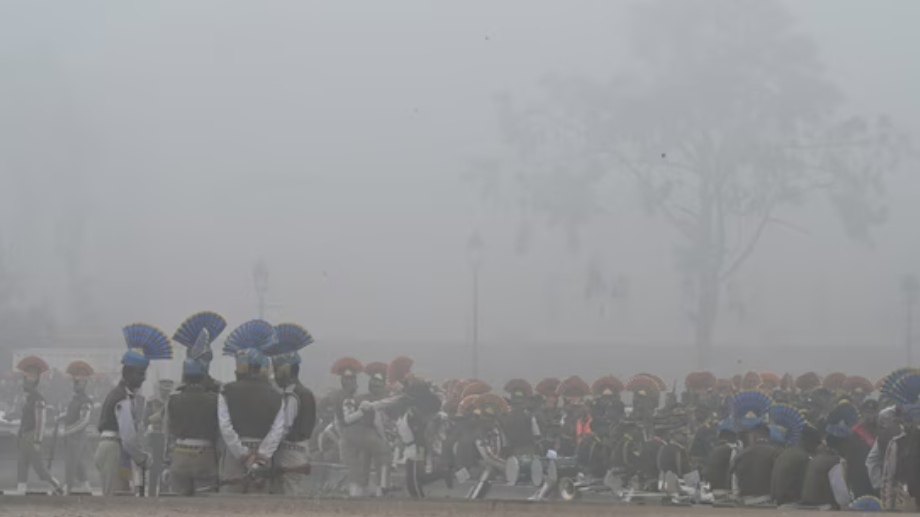
Senior officials cited slow wind speeds, a stable atmosphere and unfavourable meteorological parameters as key reasons behind the sharp rise in pollution. With limited dispersion of pollutants, emissions have accumulated over the region, turning winter fog into toxic smog laden with particulate matter. “Forecasts indicate that Delhi’s average AQI is likely to breach the 400-mark and remain in the severe category in the coming days,” an official had warned earlier, according to PTI.
The worsening air quality coincides with intense winter conditions in the national capital. On Saturday, Delhi recorded a minimum temperature of 4.4 degrees Celsius, around 3.2 degrees below the seasonal average, as per the India Meteorological Department (IMD). Dense fog prevailed during the morning hours, though the maximum temperature rose to 24.6 degrees Celsius, about five degrees above normal.
Weather experts say some relief may be temporary. Skymet Weather’s Mahesh Palawat noted that minimum temperatures are expected to rise gradually between January 17 and 20, with light winter rainfall possible over the next few days. However, he also warned of another cold spell between January 23 and 26, when temperatures could dip again, potentially worsening pollution levels.
With Republic Day approaching and outdoor activities underway, including parade rehearsals, authorities are on high alert as residents brace for stricter restrictions and continued health concerns due to hazardous air conditions.





 English
 Gujarati
 Hindi
Hindi Kannada
 Malayalam
 Marathi
 Punjabi
 Tamil
Tamil Telugu