





 India
India

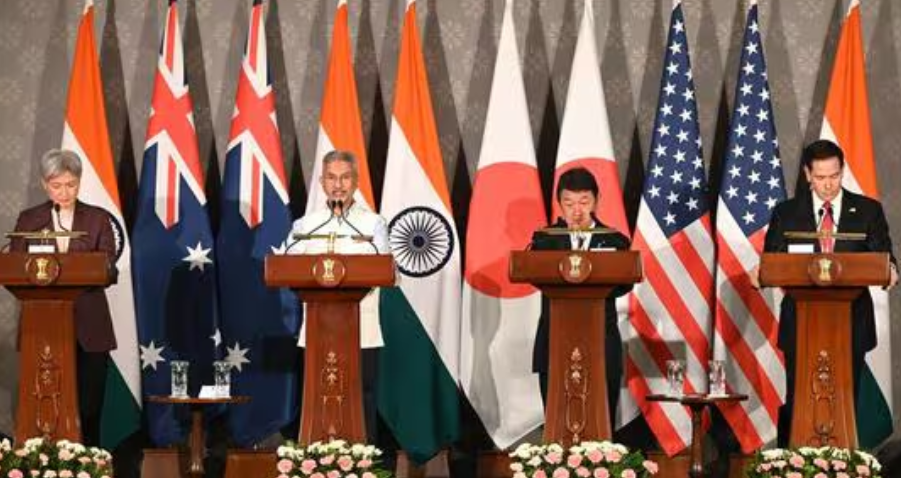
In a significant move aimed at bolstering regional resilience amid ongoing instability in West Asia, the Quad grouping on Tuesday unveiled a new Indo-Pacific energy security initiative and announced its first joint infrastructure project in Fiji, while also expanding cooperation on maritime surveillance, critical minerals, telecommunications, and undersea cable connectivity.
The announcements came after a meeting of the Quad foreign ministers in New Delhi, attended by India’s External Affairs Minister S. Jaishankar, US Secretary of State Marco Rubio, Australia’s Foreign Minister Penny Wong, and Japan’s Foreign Minister Toshimitsu Motegi. The four leaders sought to inject fresh momentum into the grouping at a time when regional tensions, supply chain vulnerabilities, and strategic competition in the Indo-Pacific continue to intensify.
The newly launched Quad Initiative on Indo-Pacific Energy Security is designed to help countries in the region cope with disruptions in fuel and energy supplies, particularly in the context of ongoing conflict in West Asia and concerns over shipping through critical chokepoints such as the Strait of Hormuz. The initiative will focus on strengthening energy resilience by leveraging the capabilities of Quad member states in areas such as technology, fuel management, emergency response systems, and strategic reserves.
As part of this effort, the US Department of Energy will host a fuel security forum later this year to further develop cooperation under the initiative. Japan also indicated that it plans to align the new framework with its own POWERR Asia programme, aimed at improving crude oil and petroleum product procurement resilience across Asia.
In another key development, the Quad announced plans to jointly work with Fiji to enhance port infrastructure, marking the grouping’s first collective infrastructure project. The initiative is intended to address inadequate port capacity in Pacific Island nations and is being viewed as a model for future Quad-backed development projects in the region.
Much of the Quad’s latest agenda reflects efforts to strengthen strategic resilience in areas where China has significant influence, including infrastructure, telecommunications, critical minerals, and maritime security. Though China was not directly named in several parts of the joint statement, the ministers voiced concern over destabilising actions in the East and South China Seas, including dangerous manoeuvres by military aircraft and coast guard vessels, coercive tactics, and threats to freedom of navigation.
The grouping also expanded maritime cooperation through the Indo-Pacific Maritime Surveillance Collaboration, which will improve real-time information-sharing and enhance monitoring of vessel activity in support of a “free and open Indo-Pacific”. India will host the second Quad-at-Sea Ship Observer Mission to improve interoperability and tackle illegal maritime activities.
On critical minerals, the Quad introduced a new framework to deepen coordination on mining, processing, recycling, and investment in strategic resources, amid concerns over China’s dominance in rare earth supply chains. The initiative is especially significant for India and Japan, both of which have previously faced disruptions linked to Chinese export restrictions.
The Quad further pledged to strengthen undersea cable connectivity in the Pacific, advance trusted 4G and 5G infrastructure, and begin collaboration on next-generation telecommunications standards, including Open RAN and future 6G technologies.
The foreign ministers also condemned terrorism in all forms, including cross-border terrorism, and expressed support for diplomatic efforts to ensure peace in West Asia and secure uninterrupted global commerce through vital maritime routes.
While China responded by cautioning against bloc politics and “exclusive cliques,” the Quad maintained that its efforts are aimed at ensuring strategic stability, resilience, and peace across the Indo-Pacific.




 English
 Gujarati
 Hindi
Hindi Kannada
 Malayalam
 Marathi
 Punjabi
 Tamil
Tamil Telugu