India
India

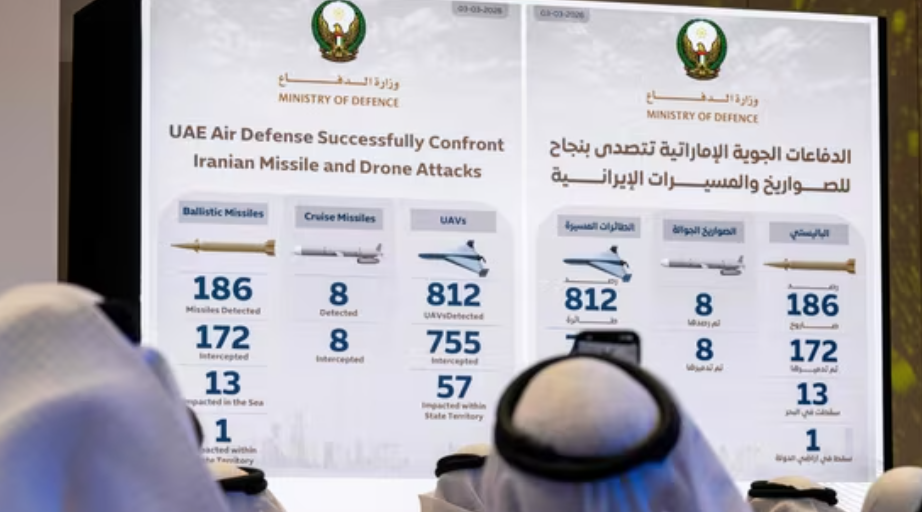
As tensions escalate in West Asia and missile exchanges intensify between Iran and the US-Israel alliance, the United Arab Emirates (UAE) has increasingly found itself within the conflict’s shadow. Despite being geographically close to the flashpoints, daily life in cities like Dubai and Abu Dhabi has largely continued uninterrupted — thanks largely to the country’s sophisticated, multi-layered air defence network.
According to the UAE Ministry of Defence, more than 1,700 missiles and drones launched by Iran have been intercepted since the conflict began. While the attacks have led to casualties — with six deaths and 131 people injured — authorities say the country’s defence systems have prevented far more severe damage.
Residents across the UAE have grown accustomed to emergency alerts on their phones warning of potential aerial threats. Government agencies, including the Ministry of Defence, issue real-time notifications advising citizens to move to shelters when necessary. Often within minutes, a follow-up message informs residents that the incoming missile or drone has been intercepted and neutralised.
Behind these alerts lies a complex and highly coordinated defence mechanism. Brigadier Staff Mohammed Al Ketbi, spokesperson for the UAE Ministry of Defence, explained that the system relies on a vast network of advanced radars and sensors that constantly scan the skies for potential threats.
Once a suspicious object is detected, information is immediately transmitted to command and control centres. There, sophisticated software systems merge data from multiple radar sources to create a detailed operational picture. This rapid analysis allows military operators to assess the type of threat, calculate its trajectory, and decide on the most effective interception method — often within seconds.
The UAE’s air defence architecture operates on a layered principle, ensuring that different types of threats are tackled at different stages of flight. The first layer focuses on early detection, with radar networks monitoring large sections of airspace to identify missiles or drones as early as possible.
After detection, the system determines the altitude, speed, and potential target of the incoming threat. Based on this analysis, the appropriate defensive layer is activated.
For high-altitude ballistic missile threats, the UAE relies heavily on the US-developed Terminal High Altitude Area Defense (THAAD) system. Notably, the UAE became the first country outside the United States to deploy this powerful missile shield.
At the medium-altitude level, Patriot PAC-3 missile batteries form another critical line of defence. These systems are capable of intercepting tactical ballistic missiles as well as hostile aircraft.
Closer to the ground, the military employs the Russian-made Pantsir-S1 system. This mobile platform combines rapid-fire cannons with short-range missiles, making it particularly effective against low-flying drones, helicopters, and aircraft.
The UAE has further strengthened its defensive shield by acquiring South Korea’s Cheongung II, also known as the M-SAM system. Designed to intercept hostile aircraft and precision-guided munitions, this medium-range system adds another protective layer to the country’s airspace defence.
Together, these systems form a tightly integrated network that significantly increases the chances of detecting, tracking, and destroying aerial threats before they can reach populated areas. Defence officials say this layered strategy is the key reason why the UAE has been able to maintain stability and safety despite repeated missile and drone attacks.






 English
 Gujarati
 Hindi
Hindi Kannada
 Malayalam
 Marathi
 Punjabi
 Tamil
Tamil Telugu