
 India
India

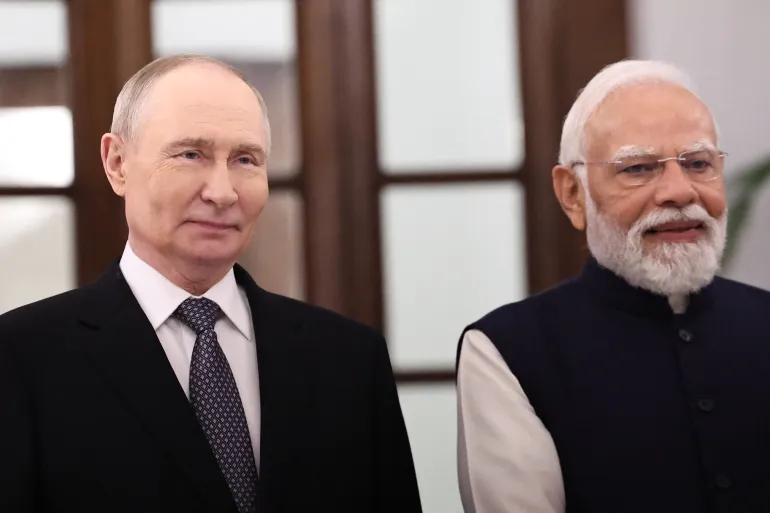
In a major development in India-US trade relations, Union Commerce Minister Piyush Goyal clarified on Saturday that the Ministry of External Affairs (MEA) will provide details on India’s stance regarding Russian oil, following claims in a U.S. executive order. The order, issued by former President Donald Trump, linked the removal of the 25% “penal” tariffs on India’s Russian oil purchases to a commitment that India will stop importing Russian oil, directly or indirectly, and increase purchases of U.S. energy products.
Titled “Modifying Duties to Address Threats to the United States by the Government of the Russian Federation,” the executive order also warns that the 25% punitive tariff could be reimposed if India resumes Russian oil imports. The statement emphasizes a framework for expanding bilateral defense cooperation over the next decade.
However, the India-US joint statement on the trade deal differs. It outlines plans for India to purchase $500 billion worth of U.S. energy, aircraft, technology, and industrial goods over the next five years, while India will reduce or eliminate tariffs on U.S. industrial and select food products. The statement does not explicitly mention Russian oil, highlighting that India’s energy strategy is guided by market conditions and the goal of ensuring energy security for 1.4 billion citizens. The MEA has repeatedly stressed that energy sourcing decisions are based on sovereign assessments of global dynamics.
The trade deal will also reduce reciprocal tariffs. Currently, the combined tariffs stood at 50%—25% linked to Russian oil and 25% as a reciprocal levy. With the penal tariff removed, only the 25% reciprocal levy remains, which is expected to drop to 18% once the interim agreement is finalized.
While PM Narendra Modi and Goyal described the framework as a step forward, opposition leaders, including former Finance Minister P. Chidambaram, criticized it as heavily skewed in favor of the U.S., emphasizing that no formal Bilateral Trade Agreement (BTA) has yet been signed. The framework, they argue, is still preliminary and lacks clarity on several points.
This announcement follows a series of recent trade milestones for India, including agreements with the European Union, Oman, and New Zealand, signaling a proactive effort to expand international economic partnerships.


 English
 Gujarati
 Hindi
Hindi Kannada
 Malayalam
 Marathi
 Punjabi
 Tamil
Tamil Telugu