 India
India

The United States launched what President Donald Trump described as “large-scale” military strikes on Venezuela early Saturday, claiming that Venezuelan President Nicolás Maduro and his wife were captured in a dramatic overnight operation and flown out of the country. In a move that has sent shockwaves across the world, Trump said the US will “run” Venezuela temporarily until a power transition is completed.
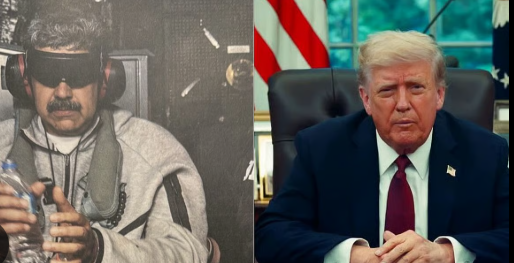
Posting on Truth Social, Trump shared what he called the first image of Maduro after his capture. The photo allegedly shows the Venezuelan leader blindfolded and dressed in a tracksuit aboard the USS Iwo Jima. Trump later confirmed during a press conference that Maduro and his wife are now in US custody and will face criminal prosecution in New York. US officials said the charges are linked to long-standing narcotics and corruption cases filed in the Southern District of New York.
According to Venezuela’s ruling party leader Nahum Fernández, the couple were seized from their residence inside the Ft Tiuna military complex in Caracas after US forces struck the area. Fernández described the operation as a “kidnapping” and accused Washington of bombing residential zones during the assault. Venezuelan authorities said multiple explosions were reported across Caracas as well as in Miranda, Aragua and La Guaira states, with unverified videos circulating online showing large blasts near infrastructure sites.
Trump defended the action, saying the United States had no choice but to intervene after Maduro refused to accept a negotiated exit. “We’re going to run the country until such time as we can do a safe, proper, and judicious transition,” Trump said, suggesting US involvement would be extensive but temporary. He also hinted at a role for opposition figures in the transition process.
Venezuela’s opposition leader and Nobel Peace Prize winner Maria Corina Machado welcomed the development, claiming Maduro’s capture followed his rejection of a peaceful handover of power. In a statement, she urged supporters to remain “vigilant, active, and organized” as the country moves toward what she called a democratic transition.
The operation has triggered fierce international condemnation. Russia termed the action “unacceptable” and demanded that Venezuela’s sovereignty be respected. China accused Washington of “hegemonic acts,” while Iran and several Latin American nations condemned the strikes as illegal military aggression. UN Secretary-General António Guterres warned that the operation sets a “dangerous precedent” and expressed deep alarm, with calls mounting for an emergency UN Security Council meeting.
India’s Ministry of External Affairs issued an advisory urging Indian nationals to avoid travel to Venezuela and asked those currently in the country to restrict movement. Meanwhile, regional fallout has intensified, with airspace disruptions in parts of the Caribbean and Colombia deploying troops along its border.

As Venezuela declared a national emergency and called for mass mobilisation, uncertainty looms over what comes next. While Trump insists the operation was “brilliant” and necessary, critics warn the intervention risks destabilising the region further and igniting a wider geopolitical confrontation over sovereignty, oil resources, and international law.
 English
 Gujarati
 Hindi
Hindi Kannada
 Malayalam
 Marathi
 Punjabi
 Tamil
Tamil Telugu