


• Home
    • All
    • Art
    • Bollywood
    • Business
    • Cricket
    • Crypto
    • Culture
    • Daily Horoscope
    • Economy
    • Elections
    • Entertainment
    • Fashion
    • Gaming
    • Health
    • History
    • India
    • Lifestyle
    • Movie Reviews
    • Photos
    • Politics
    • Sci-Tech
    • Science
    • Sports
    • Tech
    • Trending
    • TV
    • Uncategorized
    • Web Series
    • World News
    NHRC Urges Police Sensitisation to Stop Victim-Shaming of Women, Calls for Patrolling at Crime Hotspots

    NHRC Urges Police Sensitisation to Stop Victim-Shaming of Women, Calls for Patrolling at Crime Hotspots

    India Calls for Stronger Global Cooperation on Disaster Risk Reduction, Resilient Infrastructure

    India Calls for Stronger Global Cooperation on Disaster Risk Reduction, Resilient Infrastructure

    ECI orders transfer of election-related officers in Goa, UP, 3 other states ahead of 2027 assembly polls The order covers EROs, ADMs, SDMs, tehsildars, block development officers, and divisional and municipal commissioners. Updated on: Oct 27, 2026, 18:20:24 IST By Himanshi Dahiya Prefer HTPrefer HT Prefer HT on Google Share The Election Commission of India (ECI) on Tuesday directed Goa, Manipur, Punjab, Uttar Pradesh and Uttarakhand to transfer officers associated with election work who are posted in their home districts or have served in the same district for three years or more, ahead of the 2027 Assembly elections.  The ECI stated that no officer covered by the directive would be allowed to continue in their present district if they meet the transfer criteria. (HT_PRINT) The ECI stated that no officer covered by the directive would be allowed to continue in their present district if they meet the transfer criteria. (HT_PRINT) In a letter to the chief secretaries and chief electoral officers of the five states, the Commission stated that no officer covered by the directive would be allowed to continue in their present district if they meet the transfer criteria.   The cut-off date for calculating the three-year tenure has been set as March 31, 2027, for Goa, Manipur, Punjab and Uttarakhand, and May 31, 2027, for Uttar Pradesh.  The Commission clarified that promotions to posts within the same district would be counted while calculating the three-year period. However, services rendered at the state headquarters during the past four years would not be included in the calculation, even if the headquarters falls within the same revenue district.  The state governments have also been instructed to ensure that transferred officers are not posted to their home districts. District election officers (DEOs), returning officers (ROs), assistant returning officers (AROs) and other designated officials cannot be posted back to the constituency or district where they served during the previous Assembly election or any by-election held since then.  The directive covers a wide range of administrative and election-related officials, including electoral registration officers (EROs), additional district magistrates (ADMs), sub-divisional magistrates (SDMs), tehsildars, block development officers, divisional commissioners and municipal commissioners.  In the police department, the order applies to officers from the rank of sub-inspector up to range inspector generals and police commissioners. Excise and transport department officials holding the rank of sub-inspector or above are also covered.  The Commission has made a separate provision for personnel involved in the ongoing Special Summary Revision of electoral rolls. Their transfer will take place only after the final publication of the electoral rolls and in consultation with the chief electoral officer.  Chief secretaries and directors general of police (DGPs) of the five states have been directed to submit compliance reports to the Commission by November 30.  Officers associated with election work will be required to submit a declaration within two days of the last date for filing nominations. The declaration must state that they are not close relatives of any contesting candidate and have no criminal cases pending against them.  The terms of the five state Assemblies are due to end between March 13, 2027, in Manipur and May 22, 2027, in Uttar Pradesh. The Election Commission has yet to announce the final schedule for the Assembly elections.

    ECI orders transfer of election-related officers in Goa, UP, 3 other states ahead of 2027 assembly polls The order covers EROs, ADMs, SDMs, tehsildars, block development officers, and divisional and municipal commissioners. Updated on: Oct 27, 2026, 18:20:24 IST By Himanshi Dahiya Prefer HTPrefer HT Prefer HT on Google Share The Election Commission of India (ECI) on Tuesday directed Goa, Manipur, Punjab, Uttar Pradesh and Uttarakhand to transfer officers associated with election work who are posted in their home districts or have served in the same district for three years or more, ahead of the 2027 Assembly elections. The ECI stated that no officer covered by the directive would be allowed to continue in their present district if they meet the transfer criteria. (HT_PRINT) The ECI stated that no officer covered by the directive would be allowed to continue in their present district if they meet the transfer criteria. (HT_PRINT) In a letter to the chief secretaries and chief electoral officers of the five states, the Commission stated that no officer covered by the directive would be allowed to continue in their present district if they meet the transfer criteria. The cut-off date for calculating the three-year tenure has been set as March 31, 2027, for Goa, Manipur, Punjab and Uttarakhand, and May 31, 2027, for Uttar Pradesh. The Commission clarified that promotions to posts within the same district would be counted while calculating the three-year period. However, services rendered at the state headquarters during the past four years would not be included in the calculation, even if the headquarters falls within the same revenue district. The state governments have also been instructed to ensure that transferred officers are not posted to their home districts. District election officers (DEOs), returning officers (ROs), assistant returning officers (AROs) and other designated officials cannot be posted back to the constituency or district where they served during the previous Assembly election or any by-election held since then. The directive covers a wide range of administrative and election-related officials, including electoral registration officers (EROs), additional district magistrates (ADMs), sub-divisional magistrates (SDMs), tehsildars, block development officers, divisional commissioners and municipal commissioners. In the police department, the order applies to officers from the rank of sub-inspector up to range inspector generals and police commissioners. Excise and transport department officials holding the rank of sub-inspector or above are also covered. The Commission has made a separate provision for personnel involved in the ongoing Special Summary Revision of electoral rolls. Their transfer will take place only after the final publication of the electoral rolls and in consultation with the chief electoral officer. Chief secretaries and directors general of police (DGPs) of the five states have been directed to submit compliance reports to the Commission by November 30. Officers associated with election work will be required to submit a declaration within two days of the last date for filing nominations. The declaration must state that they are not close relatives of any contesting candidate and have no criminal cases pending against them. The terms of the five state Assemblies are due to end between March 13, 2027, in Manipur and May 22, 2027, in Uttar Pradesh. The Election Commission has yet to announce the final schedule for the Assembly elections.

    New rules on animal testing must take India forward, not backwards: Maneka Gandhi Officials maintain the changes seek to simplify approvals for research institutions, pharmaceutical and biomedical industries. Updated on: Oct 26, 2026, 14:54:47 IST By Jasjeev Gandhiok Prefer HTPrefer HT Prefer HT on Google Share The Centre’s draft rules governing animal experimentation have triggered concerns among animal rights groups, which say the changes could weaken independent oversight and make it easier for laboratories to conduct experiments on animals. However, officials maintain the changes seek to simplify approvals for research institutions, pharmaceutical and biomedical industries. Former Union minister Maneka Gandhi. Former Union minister Maneka Gandhi. HT speaks to animal rights activist and former Union minister Maneka Gandhi, a long-time campaigner against animal experimentation. Edited excerpts: A major change to animal experimentation, proposed in the draft, is that mild and moderate experiments could be approved by an institution’s own ethics committee rather than going to the central regulator. In practical terms, what does this change mean for an animal inside a laboratory? Does it make it easier for more animals to be experimented on? It means the animal loses the one independent pair of eyes that was looking at its fate. Today, experiments on animals larger than a rat go to the central regulator, and there is at least someone outside the building asking whether this experiment is necessary at all. Under the draft, the people who want to do the experiment, their colleagues and their department heads will be the ones approving it. And it is the institution itself, through its own veterinarian, that decides whether the experiment is mild or moderate in the first place. No institution has ever turned down its own funding. So yes, it will make it easier, and it will make it faster, and that means more animals. Mild and moderate are also the bulk of experiments, so we are effectively handing over most of animal experimentation in India to self regulation. The draft classifies experiments as mild, moderate, severe and non-recovery. Is there a concern that the institution conducting the research will effectively decide how severe the experiment is. Does this leave a grey area? It isn’t grey, it is completely black. Under this draft, the institution that wants to do the experiment is also the one that decides which category it falls into. That decision matters enormously, because if the experiment is classified as mild or moderate, the institution’s own committee approves it and it never goes to the central regulator. Only severe and non-recovery experiments on larger animals go outside. So the same people who want the experiment approved are deciding whether anyone independent will ever examine it. That is a clear conflict of interest, and it will push experiments towards the lower categories. Starving a rat for a day is called mild. Keeping a social animal alone in a cage is mild. Starving it for two days, or putting it through distress it cannot escape, is moderate. So is testing herbal products, testing established drugs, and anything described as having “known and reversible effects,” which could mean almost anything. This is not a scientific list. It is the most common commercial work. The draft also creates exceptions and allows laboratories to use animals from open markets, unregistered sources, and in certain circumstances, stray, feral, wild and protected animals. What is the biggest risk that this may create for animals in practice? Could community dogs, lost pets or animals taken from the wild find their way into laboratories? The biggest risk is that nobody will know where an animal came from. The whole point of registered breeders was traceability. Once you allow open markets and unregistered sources for cattle, goats, birds and fish, you create a demand, and in this country demand is met very quickly by people who will pick up anything. Strays and wild animals can be used if a “competent authority” permits it, and the draft never says who that is. Community dogs, someone’s lost pet, birds from illegal markets, all of it can find its way into a laboratory. These exceptions should be removed completely. If a lab cannot get an animal from a registered source, it should not be doing that experiment. The draft formally incorporates the principles of replacement, reduction and refinement, but critics say these safeguards become weaker if institutions themselves are approving experiments. Do you believe India should now be moving towards replacing animal experiments altogether, particularly when the health ministry has already allowed certain drug testing through non-animal methods? What should the rules do differently? Yes, and we are not starting from zero. The health ministry has already amended the drug rules to accept non-animal methods. The world is moving this way because these methods are often more predictive for humans than a mouse ever was. Writing replacement, reduction and refinement into the rules means nothing if the person checking compliance is the institution itself. The rules should make it mandatory to show that no validated alternative exists before an animal is used, set up a national body to validate and promote alternatives, put money into them, and set timelines to phase out animal use in areas where alternatives are already available. A rule that only mentions replacement as a principle is decoration. You have worked on animal experimentation regulation for decades. What specific changes would you want the government to make to this draft? I don’t think this draft can be fixed. There is hardly a provision in it that doesn’t need changing, and when everything needs to change, it is better to start again. So the draft should be put aside and written afresh, this time with independent scientists, animal welfare organisations and legal experts at the table. The new rules must take India forward, not backwards. Animals already have certain protections under the law which cannot be taken away. New should be building on them.

    New rules on animal testing must take India forward, not backwards: Maneka Gandhi Officials maintain the changes seek to simplify approvals for research institutions, pharmaceutical and biomedical industries. Updated on: Oct 26, 2026, 14:54:47 IST By Jasjeev Gandhiok Prefer HTPrefer HT Prefer HT on Google Share The Centre’s draft rules governing animal experimentation have triggered concerns among animal rights groups, which say the changes could weaken independent oversight and make it easier for laboratories to conduct experiments on animals. However, officials maintain the changes seek to simplify approvals for research institutions, pharmaceutical and biomedical industries. Former Union minister Maneka Gandhi. Former Union minister Maneka Gandhi. HT speaks to animal rights activist and former Union minister Maneka Gandhi, a long-time campaigner against animal experimentation. Edited excerpts: A major change to animal experimentation, proposed in the draft, is that mild and moderate experiments could be approved by an institution’s own ethics committee rather than going to the central regulator. In practical terms, what does this change mean for an animal inside a laboratory? Does it make it easier for more animals to be experimented on? It means the animal loses the one independent pair of eyes that was looking at its fate. Today, experiments on animals larger than a rat go to the central regulator, and there is at least someone outside the building asking whether this experiment is necessary at all. Under the draft, the people who want to do the experiment, their colleagues and their department heads will be the ones approving it. And it is the institution itself, through its own veterinarian, that decides whether the experiment is mild or moderate in the first place. No institution has ever turned down its own funding. So yes, it will make it easier, and it will make it faster, and that means more animals. Mild and moderate are also the bulk of experiments, so we are effectively handing over most of animal experimentation in India to self regulation. The draft classifies experiments as mild, moderate, severe and non-recovery. Is there a concern that the institution conducting the research will effectively decide how severe the experiment is. Does this leave a grey area? It isn’t grey, it is completely black. Under this draft, the institution that wants to do the experiment is also the one that decides which category it falls into. That decision matters enormously, because if the experiment is classified as mild or moderate, the institution’s own committee approves it and it never goes to the central regulator. Only severe and non-recovery experiments on larger animals go outside. So the same people who want the experiment approved are deciding whether anyone independent will ever examine it. That is a clear conflict of interest, and it will push experiments towards the lower categories. Starving a rat for a day is called mild. Keeping a social animal alone in a cage is mild. Starving it for two days, or putting it through distress it cannot escape, is moderate. So is testing herbal products, testing established drugs, and anything described as having “known and reversible effects,” which could mean almost anything. This is not a scientific list. It is the most common commercial work. The draft also creates exceptions and allows laboratories to use animals from open markets, unregistered sources, and in certain circumstances, stray, feral, wild and protected animals. What is the biggest risk that this may create for animals in practice? Could community dogs, lost pets or animals taken from the wild find their way into laboratories? The biggest risk is that nobody will know where an animal came from. The whole point of registered breeders was traceability. Once you allow open markets and unregistered sources for cattle, goats, birds and fish, you create a demand, and in this country demand is met very quickly by people who will pick up anything. Strays and wild animals can be used if a “competent authority” permits it, and the draft never says who that is. Community dogs, someone’s lost pet, birds from illegal markets, all of it can find its way into a laboratory. These exceptions should be removed completely. If a lab cannot get an animal from a registered source, it should not be doing that experiment. The draft formally incorporates the principles of replacement, reduction and refinement, but critics say these safeguards become weaker if institutions themselves are approving experiments. Do you believe India should now be moving towards replacing animal experiments altogether, particularly when the health ministry has already allowed certain drug testing through non-animal methods? What should the rules do differently? Yes, and we are not starting from zero. The health ministry has already amended the drug rules to accept non-animal methods. The world is moving this way because these methods are often more predictive for humans than a mouse ever was. Writing replacement, reduction and refinement into the rules means nothing if the person checking compliance is the institution itself. The rules should make it mandatory to show that no validated alternative exists before an animal is used, set up a national body to validate and promote alternatives, put money into them, and set timelines to phase out animal use in areas where alternatives are already available. A rule that only mentions replacement as a principle is decoration. You have worked on animal experimentation regulation for decades. What specific changes would you want the government to make to this draft? I don’t think this draft can be fixed. There is hardly a provision in it that doesn’t need changing, and when everything needs to change, it is better to start again. So the draft should be put aside and written afresh, this time with independent scientists, animal welfare organisations and legal experts at the table. The new rules must take India forward, not backwards. Animals already have certain protections under the law which cannot be taken away. New should be building on them.

    Orissa High Court Rules SC/ST Status Cannot Be Carried Across State Borders

    Orissa High Court Rules SC/ST Status Cannot Be Carried Across State Borders

    Supreme Court Seeks Centre’s Response to Challenge Against Chhattisgarh Anti-Conversion Law

    Supreme Court Seeks Centre’s Response to Challenge Against Chhattisgarh Anti-Conversion Law

    Trending Tags

    • Movie
    • Music
  • Trending
  • India
    • Politics
    • States
    • Elections
    • Results
  • World News
  • Business
    • Economy
    • Markets
    • Real Estate
    • Crypto
  • More
    • Entertainment
      • Bollywood
      • TV
      • Movie Reviews
      • Web Series
    • Sports
      • Cricket
      • Football
      • Games
    • Sci-Tech
      • Science
      • Tech
      • Gadgets
      • Gaming
    • Culture
      • History
      • Festivals
      • Art
      • Temples
      • Scriptures
    • Lifestyle
      • Fashion
      • Food
      • Health
      • Travel
    • Student’s Corner
      • Exam
      • Exam Results
      • Schools
      • Universities
    • Astrology
      • Daily Horoscope
      • Monthly Horoscope
      • Days
  • Opinion
  • Login
  • Register
  • Home
    • All
    • Art
    • Bollywood
    • Business
    • Cricket
    • Crypto
    • Culture
    • Daily Horoscope
    • Economy
    • Elections
    • Entertainment
    • Fashion
    • Gaming
    • Health
    • History
    • India
    • Lifestyle
    • Movie Reviews
    • Photos
    • Politics
    • Sci-Tech
    • Science
    • Sports
    • Tech
    • Trending
    • TV
    • Uncategorized
    • Web Series
    • World News
    NHRC Urges Police Sensitisation to Stop Victim-Shaming of Women, Calls for Patrolling at Crime Hotspots

    NHRC Urges Police Sensitisation to Stop Victim-Shaming of Women, Calls for Patrolling at Crime Hotspots

    India Calls for Stronger Global Cooperation on Disaster Risk Reduction, Resilient Infrastructure

    India Calls for Stronger Global Cooperation on Disaster Risk Reduction, Resilient Infrastructure

    ECI orders transfer of election-related officers in Goa, UP, 3 other states ahead of 2027 assembly polls The order covers EROs, ADMs, SDMs, tehsildars, block development officers, and divisional and municipal commissioners. Updated on: Oct 27, 2026, 18:20:24 IST By Himanshi Dahiya Prefer HTPrefer HT Prefer HT on Google Share The Election Commission of India (ECI) on Tuesday directed Goa, Manipur, Punjab, Uttar Pradesh and Uttarakhand to transfer officers associated with election work who are posted in their home districts or have served in the same district for three years or more, ahead of the 2027 Assembly elections.  The ECI stated that no officer covered by the directive would be allowed to continue in their present district if they meet the transfer criteria. (HT_PRINT) The ECI stated that no officer covered by the directive would be allowed to continue in their present district if they meet the transfer criteria. (HT_PRINT) In a letter to the chief secretaries and chief electoral officers of the five states, the Commission stated that no officer covered by the directive would be allowed to continue in their present district if they meet the transfer criteria.   The cut-off date for calculating the three-year tenure has been set as March 31, 2027, for Goa, Manipur, Punjab and Uttarakhand, and May 31, 2027, for Uttar Pradesh.  The Commission clarified that promotions to posts within the same district would be counted while calculating the three-year period. However, services rendered at the state headquarters during the past four years would not be included in the calculation, even if the headquarters falls within the same revenue district.  The state governments have also been instructed to ensure that transferred officers are not posted to their home districts. District election officers (DEOs), returning officers (ROs), assistant returning officers (AROs) and other designated officials cannot be posted back to the constituency or district where they served during the previous Assembly election or any by-election held since then.  The directive covers a wide range of administrative and election-related officials, including electoral registration officers (EROs), additional district magistrates (ADMs), sub-divisional magistrates (SDMs), tehsildars, block development officers, divisional commissioners and municipal commissioners.  In the police department, the order applies to officers from the rank of sub-inspector up to range inspector generals and police commissioners. Excise and transport department officials holding the rank of sub-inspector or above are also covered.  The Commission has made a separate provision for personnel involved in the ongoing Special Summary Revision of electoral rolls. Their transfer will take place only after the final publication of the electoral rolls and in consultation with the chief electoral officer.  Chief secretaries and directors general of police (DGPs) of the five states have been directed to submit compliance reports to the Commission by November 30.  Officers associated with election work will be required to submit a declaration within two days of the last date for filing nominations. The declaration must state that they are not close relatives of any contesting candidate and have no criminal cases pending against them.  The terms of the five state Assemblies are due to end between March 13, 2027, in Manipur and May 22, 2027, in Uttar Pradesh. The Election Commission has yet to announce the final schedule for the Assembly elections.

    ECI orders transfer of election-related officers in Goa, UP, 3 other states ahead of 2027 assembly polls The order covers EROs, ADMs, SDMs, tehsildars, block development officers, and divisional and municipal commissioners. Updated on: Oct 27, 2026, 18:20:24 IST By Himanshi Dahiya Prefer HTPrefer HT Prefer HT on Google Share The Election Commission of India (ECI) on Tuesday directed Goa, Manipur, Punjab, Uttar Pradesh and Uttarakhand to transfer officers associated with election work who are posted in their home districts or have served in the same district for three years or more, ahead of the 2027 Assembly elections. The ECI stated that no officer covered by the directive would be allowed to continue in their present district if they meet the transfer criteria. (HT_PRINT) The ECI stated that no officer covered by the directive would be allowed to continue in their present district if they meet the transfer criteria. (HT_PRINT) In a letter to the chief secretaries and chief electoral officers of the five states, the Commission stated that no officer covered by the directive would be allowed to continue in their present district if they meet the transfer criteria. The cut-off date for calculating the three-year tenure has been set as March 31, 2027, for Goa, Manipur, Punjab and Uttarakhand, and May 31, 2027, for Uttar Pradesh. The Commission clarified that promotions to posts within the same district would be counted while calculating the three-year period. However, services rendered at the state headquarters during the past four years would not be included in the calculation, even if the headquarters falls within the same revenue district. The state governments have also been instructed to ensure that transferred officers are not posted to their home districts. District election officers (DEOs), returning officers (ROs), assistant returning officers (AROs) and other designated officials cannot be posted back to the constituency or district where they served during the previous Assembly election or any by-election held since then. The directive covers a wide range of administrative and election-related officials, including electoral registration officers (EROs), additional district magistrates (ADMs), sub-divisional magistrates (SDMs), tehsildars, block development officers, divisional commissioners and municipal commissioners. In the police department, the order applies to officers from the rank of sub-inspector up to range inspector generals and police commissioners. Excise and transport department officials holding the rank of sub-inspector or above are also covered. The Commission has made a separate provision for personnel involved in the ongoing Special Summary Revision of electoral rolls. Their transfer will take place only after the final publication of the electoral rolls and in consultation with the chief electoral officer. Chief secretaries and directors general of police (DGPs) of the five states have been directed to submit compliance reports to the Commission by November 30. Officers associated with election work will be required to submit a declaration within two days of the last date for filing nominations. The declaration must state that they are not close relatives of any contesting candidate and have no criminal cases pending against them. The terms of the five state Assemblies are due to end between March 13, 2027, in Manipur and May 22, 2027, in Uttar Pradesh. The Election Commission has yet to announce the final schedule for the Assembly elections.

    New rules on animal testing must take India forward, not backwards: Maneka Gandhi Officials maintain the changes seek to simplify approvals for research institutions, pharmaceutical and biomedical industries. Updated on: Oct 26, 2026, 14:54:47 IST By Jasjeev Gandhiok Prefer HTPrefer HT Prefer HT on Google Share The Centre’s draft rules governing animal experimentation have triggered concerns among animal rights groups, which say the changes could weaken independent oversight and make it easier for laboratories to conduct experiments on animals. However, officials maintain the changes seek to simplify approvals for research institutions, pharmaceutical and biomedical industries. Former Union minister Maneka Gandhi. Former Union minister Maneka Gandhi. HT speaks to animal rights activist and former Union minister Maneka Gandhi, a long-time campaigner against animal experimentation. Edited excerpts: A major change to animal experimentation, proposed in the draft, is that mild and moderate experiments could be approved by an institution’s own ethics committee rather than going to the central regulator. In practical terms, what does this change mean for an animal inside a laboratory? Does it make it easier for more animals to be experimented on? It means the animal loses the one independent pair of eyes that was looking at its fate. Today, experiments on animals larger than a rat go to the central regulator, and there is at least someone outside the building asking whether this experiment is necessary at all. Under the draft, the people who want to do the experiment, their colleagues and their department heads will be the ones approving it. And it is the institution itself, through its own veterinarian, that decides whether the experiment is mild or moderate in the first place. No institution has ever turned down its own funding. So yes, it will make it easier, and it will make it faster, and that means more animals. Mild and moderate are also the bulk of experiments, so we are effectively handing over most of animal experimentation in India to self regulation. The draft classifies experiments as mild, moderate, severe and non-recovery. Is there a concern that the institution conducting the research will effectively decide how severe the experiment is. Does this leave a grey area? It isn’t grey, it is completely black. Under this draft, the institution that wants to do the experiment is also the one that decides which category it falls into. That decision matters enormously, because if the experiment is classified as mild or moderate, the institution’s own committee approves it and it never goes to the central regulator. Only severe and non-recovery experiments on larger animals go outside. So the same people who want the experiment approved are deciding whether anyone independent will ever examine it. That is a clear conflict of interest, and it will push experiments towards the lower categories. Starving a rat for a day is called mild. Keeping a social animal alone in a cage is mild. Starving it for two days, or putting it through distress it cannot escape, is moderate. So is testing herbal products, testing established drugs, and anything described as having “known and reversible effects,” which could mean almost anything. This is not a scientific list. It is the most common commercial work. The draft also creates exceptions and allows laboratories to use animals from open markets, unregistered sources, and in certain circumstances, stray, feral, wild and protected animals. What is the biggest risk that this may create for animals in practice? Could community dogs, lost pets or animals taken from the wild find their way into laboratories? The biggest risk is that nobody will know where an animal came from. The whole point of registered breeders was traceability. Once you allow open markets and unregistered sources for cattle, goats, birds and fish, you create a demand, and in this country demand is met very quickly by people who will pick up anything. Strays and wild animals can be used if a “competent authority” permits it, and the draft never says who that is. Community dogs, someone’s lost pet, birds from illegal markets, all of it can find its way into a laboratory. These exceptions should be removed completely. If a lab cannot get an animal from a registered source, it should not be doing that experiment. The draft formally incorporates the principles of replacement, reduction and refinement, but critics say these safeguards become weaker if institutions themselves are approving experiments. Do you believe India should now be moving towards replacing animal experiments altogether, particularly when the health ministry has already allowed certain drug testing through non-animal methods? What should the rules do differently? Yes, and we are not starting from zero. The health ministry has already amended the drug rules to accept non-animal methods. The world is moving this way because these methods are often more predictive for humans than a mouse ever was. Writing replacement, reduction and refinement into the rules means nothing if the person checking compliance is the institution itself. The rules should make it mandatory to show that no validated alternative exists before an animal is used, set up a national body to validate and promote alternatives, put money into them, and set timelines to phase out animal use in areas where alternatives are already available. A rule that only mentions replacement as a principle is decoration. You have worked on animal experimentation regulation for decades. What specific changes would you want the government to make to this draft? I don’t think this draft can be fixed. There is hardly a provision in it that doesn’t need changing, and when everything needs to change, it is better to start again. So the draft should be put aside and written afresh, this time with independent scientists, animal welfare organisations and legal experts at the table. The new rules must take India forward, not backwards. Animals already have certain protections under the law which cannot be taken away. New should be building on them.

    New rules on animal testing must take India forward, not backwards: Maneka Gandhi Officials maintain the changes seek to simplify approvals for research institutions, pharmaceutical and biomedical industries. Updated on: Oct 26, 2026, 14:54:47 IST By Jasjeev Gandhiok Prefer HTPrefer HT Prefer HT on Google Share The Centre’s draft rules governing animal experimentation have triggered concerns among animal rights groups, which say the changes could weaken independent oversight and make it easier for laboratories to conduct experiments on animals. However, officials maintain the changes seek to simplify approvals for research institutions, pharmaceutical and biomedical industries. Former Union minister Maneka Gandhi. Former Union minister Maneka Gandhi. HT speaks to animal rights activist and former Union minister Maneka Gandhi, a long-time campaigner against animal experimentation. Edited excerpts: A major change to animal experimentation, proposed in the draft, is that mild and moderate experiments could be approved by an institution’s own ethics committee rather than going to the central regulator. In practical terms, what does this change mean for an animal inside a laboratory? Does it make it easier for more animals to be experimented on? It means the animal loses the one independent pair of eyes that was looking at its fate. Today, experiments on animals larger than a rat go to the central regulator, and there is at least someone outside the building asking whether this experiment is necessary at all. Under the draft, the people who want to do the experiment, their colleagues and their department heads will be the ones approving it. And it is the institution itself, through its own veterinarian, that decides whether the experiment is mild or moderate in the first place. No institution has ever turned down its own funding. So yes, it will make it easier, and it will make it faster, and that means more animals. Mild and moderate are also the bulk of experiments, so we are effectively handing over most of animal experimentation in India to self regulation. The draft classifies experiments as mild, moderate, severe and non-recovery. Is there a concern that the institution conducting the research will effectively decide how severe the experiment is. Does this leave a grey area? It isn’t grey, it is completely black. Under this draft, the institution that wants to do the experiment is also the one that decides which category it falls into. That decision matters enormously, because if the experiment is classified as mild or moderate, the institution’s own committee approves it and it never goes to the central regulator. Only severe and non-recovery experiments on larger animals go outside. So the same people who want the experiment approved are deciding whether anyone independent will ever examine it. That is a clear conflict of interest, and it will push experiments towards the lower categories. Starving a rat for a day is called mild. Keeping a social animal alone in a cage is mild. Starving it for two days, or putting it through distress it cannot escape, is moderate. So is testing herbal products, testing established drugs, and anything described as having “known and reversible effects,” which could mean almost anything. This is not a scientific list. It is the most common commercial work. The draft also creates exceptions and allows laboratories to use animals from open markets, unregistered sources, and in certain circumstances, stray, feral, wild and protected animals. What is the biggest risk that this may create for animals in practice? Could community dogs, lost pets or animals taken from the wild find their way into laboratories? The biggest risk is that nobody will know where an animal came from. The whole point of registered breeders was traceability. Once you allow open markets and unregistered sources for cattle, goats, birds and fish, you create a demand, and in this country demand is met very quickly by people who will pick up anything. Strays and wild animals can be used if a “competent authority” permits it, and the draft never says who that is. Community dogs, someone’s lost pet, birds from illegal markets, all of it can find its way into a laboratory. These exceptions should be removed completely. If a lab cannot get an animal from a registered source, it should not be doing that experiment. The draft formally incorporates the principles of replacement, reduction and refinement, but critics say these safeguards become weaker if institutions themselves are approving experiments. Do you believe India should now be moving towards replacing animal experiments altogether, particularly when the health ministry has already allowed certain drug testing through non-animal methods? What should the rules do differently? Yes, and we are not starting from zero. The health ministry has already amended the drug rules to accept non-animal methods. The world is moving this way because these methods are often more predictive for humans than a mouse ever was. Writing replacement, reduction and refinement into the rules means nothing if the person checking compliance is the institution itself. The rules should make it mandatory to show that no validated alternative exists before an animal is used, set up a national body to validate and promote alternatives, put money into them, and set timelines to phase out animal use in areas where alternatives are already available. A rule that only mentions replacement as a principle is decoration. You have worked on animal experimentation regulation for decades. What specific changes would you want the government to make to this draft? I don’t think this draft can be fixed. There is hardly a provision in it that doesn’t need changing, and when everything needs to change, it is better to start again. So the draft should be put aside and written afresh, this time with independent scientists, animal welfare organisations and legal experts at the table. The new rules must take India forward, not backwards. Animals already have certain protections under the law which cannot be taken away. New should be building on them.

    Orissa High Court Rules SC/ST Status Cannot Be Carried Across State Borders

    Orissa High Court Rules SC/ST Status Cannot Be Carried Across State Borders

    Supreme Court Seeks Centre’s Response to Challenge Against Chhattisgarh Anti-Conversion Law

    Supreme Court Seeks Centre’s Response to Challenge Against Chhattisgarh Anti-Conversion Law

    Trending Tags

    • Movie
    • Music
  • Trending
  • India
    • Politics
    • States
    • Elections
    • Results
  • World News
  • Business
    • Economy
    • Markets
    • Real Estate
    • Crypto
  • More
    • Entertainment
      • Bollywood
      • TV
      • Movie Reviews
      • Web Series
    • Sports
      • Cricket
      • Football
      • Games
    • Sci-Tech
      • Science
      • Tech
      • Gadgets
      • Gaming
    • Culture
      • History
      • Festivals
      • Art
      • Temples
      • Scriptures
    • Lifestyle
      • Fashion
      • Food
      • Health
      • Travel
    • Student’s Corner
      • Exam
      • Exam Results
      • Schools
      • Universities
    • Astrology
      • Daily Horoscope
      • Monthly Horoscope
      • Days
  • Opinion
No Result
View All Result
India Reflects
No Result
View All Result
Home Sports

D Gukesh Becomes Youngest World Chess Champion with Historic Win Over Ding Liren

18-year-old Gukesh Dommaraju defeats China's Ding Liren in a dramatic finale to claim the World Chess Championship title in Singapore.

News Desk by News Desk
December 12, 2024
Reading Time: 1 min read
0
D gukesh

D gukesh

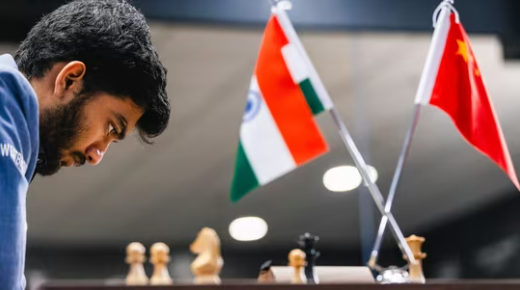
India’s chess prodigy Gukesh Dommaraju made history on Thursday, becoming the youngest-ever world chess champion at just 18 years old. Gukesh defeated defending champion Ding Liren of China in a tense and dramatic 14th game of the FIDE World Chess Championship 2024 held in Singapore. A critical blunder by Liren in the endgame sealed the match in Gukesh’s favour, making him the 18th world champion.

RELATED POSTS

Pakistan set to face India in T20 World Cup after ICC resolves PCB, BCB dispute

“India can play cricket with Pakistan, why can’t Sonam Wangchuk attend UN conference?” Wife questions

Pakistan vs West Indies: Rizwan And Saud Shine As Pakistan Stages A Fightback on Day 1

Gukesh’s triumph, achieved four years earlier than Garry Kasparov’s record in 1985, came after a 14-round classical match with a prize fund of $2.5 million. Gukesh edged out Liren with a score of 7.5–6.5, clinching victory with the black pieces in the decisive game.

Reflecting on his win, Gukesh said, “I probably got so emotional because I did not really expect to win that position.”

Ding Liren, who had previously defeated Ian Nepomniachtchi in 2023 to claim the title, struggled throughout the match. While he managed to tie the score in round 12 with a celebrated victory, his inconsistency proved costly in the finale.

Gukesh’s rise to the top began with a win at the Candidates Tournament in April, where he outperformed fellow Indians Praggnanandhaa and Vidit Gujrathi. His success is a testament to India’s growing chess prowess, spurred by the efforts of former world champion Viswanathan Anand and the nation’s gold-medal victories at the 45th Chess Olympiad.

As Magnus Carlsen, who relinquished his title in 2022, remains the top-ranked player globally, Gukesh sees his win as an opportunity to further motivate himself. “Becoming the world champion doesn’t mean that I’m the best player in the world. Obviously, there’s Magnus,” Gukesh remarked.

With this historic feat, Gukesh has firmly placed himself in the annals of chess history, inspiring a new generation of players.

Buy JNews
ADVERTISEMENT
Tags: Chess NewsD GukeshDing LirenFIDE World Chess Championship 2024Gukesh DommarajuIndia Chess PlayersWorld Chess ChampionYoungest Chess Champion
Share201Tweet126
News Desk

News Desk

A passionate news person, trying to reflect her views on the recent happenings around the globe, bringing you a nuanced perspective and keeping the ethics of journalism alive in the process. My journey started in an international newsroom, where I have covered major events and been to the roots of them.  The  South-Asian region has also caught my interest, where I have covered more of the features and cultural side of the South-Asian countries. As a journalist dedicated to ethical reporting and with a personal interest in exposing hidden narratives, I aim to offer complex perspectives that enhance comprehension of the modern, globalized world.

Related Posts

Pakistan set to face India in T20 World Cup after ICC resolves PCB, BCB dispute
Sports

Pakistan set to face India in T20 World Cup after ICC resolves PCB, BCB dispute

February 9, 2026
Sports

“India can play cricket with Pakistan, why can’t Sonam Wangchuk attend UN conference?” Wife questions

September 28, 2025
Pakistan vs West Indies: Rizwan And Saud Shine As Pakistan Stages A Fightback on Day 1
Sports

Pakistan vs West Indies: Rizwan And Saud Shine As Pakistan Stages A Fightback on Day 1

January 17, 2025
Barcelona vs Real Betis LIVE Streaming, Copa Del Rey 2024/25: How And Where To Watch
Sports

Barcelona vs Real Betis LIVE Streaming, Copa Del Rey 2024/25: How And Where To Watch

January 16, 2025
USA beat China to top the medal standings in Paris
India

PM Modi Applauds Stellar Performances of Indian Contingent as Games Draw to a Close

August 12, 2024
Although Neeraj Chopra couldn't defend his gold from Tokyo, he gave India its first silver medal of Paris Olympics 2024.(PTI)
India

Neeraj Chopra Secures India’s First Silver at Paris Olympics in Men’s Javelin; Pakistan’s Arshad Nadeem Claims Gold

August 9, 2024
Live Cricket Scores
en English
en Englishgu Gujaratihi Hindikn Kannadaml Malayalammr Marathipa Punjabita Tamilte Telugu

Recommended Stories

Army chief General Manoj Pande. (ANI)

India’s Statecraft Heritage Enriches Defense Domain, Says General Pande

May 21, 2024
Living God Ganesh Rodin Shakya is presented in front of the crowd while being carried into his chariot during the annual Indra Jatra festival to worship Indra, Kumari

Festival Season Begins in Nepal as Devotees Pay Homage to the Living Goddess

September 18, 2024
Trump, Modi Likely to Hold Bilateral Meeting During G7 Summit in France Next Week

Trump, Modi Likely to Hold Bilateral Meeting During G7 Summit in France Next Week

June 13, 2026

Popular Stories

  • Incredible Health Benefits of Walking 5,000 Steps a Day

    Incredible Health Benefits of Walking 5,000 Steps a Day

    823 shares
    Share 329 Tweet 206
  • Jeet Adani Asks Anupam Mittal To Remove His Shaadi.com Profile Days Before Wedding To Diva Shah

    597 shares
    Share 239 Tweet 149
  • UK Welcomes PM Modi – Wembley Stadium

    557 shares
    Share 223 Tweet 139
  • Mangalyaan: India’s Mars Orbiter craft quietly bids goodbye

    532 shares
    Share 213 Tweet 133
  • “Vikram Vedha”; 15 cities receive live broadcasts of the song

    530 shares
    Share 212 Tweet 133
India Reflects

India Reflects

India's first truly global news portal brings you unbiased news based on facts from India and around the World.

Recent Posts

  • NHRC Urges Police Sensitisation to Stop Victim-Shaming of Women, Calls for Patrolling at Crime Hotspots
  • India Calls for Stronger Global Cooperation on Disaster Risk Reduction, Resilient Infrastructure
  • ECI orders transfer of election-related officers in Goa, UP, 3 other states ahead of 2027 assembly polls The order covers EROs, ADMs, SDMs, tehsildars, block development officers, and divisional and municipal commissioners. Updated on: Oct 27, 2026, 18:20:24 IST By Himanshi Dahiya Prefer HTPrefer HT Prefer HT on Google Share The Election Commission of India (ECI) on Tuesday directed Goa, Manipur, Punjab, Uttar Pradesh and Uttarakhand to transfer officers associated with election work who are posted in their home districts or have served in the same district for three years or more, ahead of the 2027 Assembly elections. The ECI stated that no officer covered by the directive would be allowed to continue in their present district if they meet the transfer criteria. (HT_PRINT) The ECI stated that no officer covered by the directive would be allowed to continue in their present district if they meet the transfer criteria. (HT_PRINT) In a letter to the chief secretaries and chief electoral officers of the five states, the Commission stated that no officer covered by the directive would be allowed to continue in their present district if they meet the transfer criteria. The cut-off date for calculating the three-year tenure has been set as March 31, 2027, for Goa, Manipur, Punjab and Uttarakhand, and May 31, 2027, for Uttar Pradesh. The Commission clarified that promotions to posts within the same district would be counted while calculating the three-year period. However, services rendered at the state headquarters during the past four years would not be included in the calculation, even if the headquarters falls within the same revenue district. The state governments have also been instructed to ensure that transferred officers are not posted to their home districts. District election officers (DEOs), returning officers (ROs), assistant returning officers (AROs) and other designated officials cannot be posted back to the constituency or district where they served during the previous Assembly election or any by-election held since then. The directive covers a wide range of administrative and election-related officials, including electoral registration officers (EROs), additional district magistrates (ADMs), sub-divisional magistrates (SDMs), tehsildars, block development officers, divisional commissioners and municipal commissioners. In the police department, the order applies to officers from the rank of sub-inspector up to range inspector generals and police commissioners. Excise and transport department officials holding the rank of sub-inspector or above are also covered. The Commission has made a separate provision for personnel involved in the ongoing Special Summary Revision of electoral rolls. Their transfer will take place only after the final publication of the electoral rolls and in consultation with the chief electoral officer. Chief secretaries and directors general of police (DGPs) of the five states have been directed to submit compliance reports to the Commission by November 30. Officers associated with election work will be required to submit a declaration within two days of the last date for filing nominations. The declaration must state that they are not close relatives of any contesting candidate and have no criminal cases pending against them. The terms of the five state Assemblies are due to end between March 13, 2027, in Manipur and May 22, 2027, in Uttar Pradesh. The Election Commission has yet to announce the final schedule for the Assembly elections.
  • New rules on animal testing must take India forward, not backwards: Maneka Gandhi Officials maintain the changes seek to simplify approvals for research institutions, pharmaceutical and biomedical industries. Updated on: Oct 26, 2026, 14:54:47 IST By Jasjeev Gandhiok Prefer HTPrefer HT Prefer HT on Google Share The Centre’s draft rules governing animal experimentation have triggered concerns among animal rights groups, which say the changes could weaken independent oversight and make it easier for laboratories to conduct experiments on animals. However, officials maintain the changes seek to simplify approvals for research institutions, pharmaceutical and biomedical industries. Former Union minister Maneka Gandhi. Former Union minister Maneka Gandhi. HT speaks to animal rights activist and former Union minister Maneka Gandhi, a long-time campaigner against animal experimentation. Edited excerpts: A major change to animal experimentation, proposed in the draft, is that mild and moderate experiments could be approved by an institution’s own ethics committee rather than going to the central regulator. In practical terms, what does this change mean for an animal inside a laboratory? Does it make it easier for more animals to be experimented on? It means the animal loses the one independent pair of eyes that was looking at its fate. Today, experiments on animals larger than a rat go to the central regulator, and there is at least someone outside the building asking whether this experiment is necessary at all. Under the draft, the people who want to do the experiment, their colleagues and their department heads will be the ones approving it. And it is the institution itself, through its own veterinarian, that decides whether the experiment is mild or moderate in the first place. No institution has ever turned down its own funding. So yes, it will make it easier, and it will make it faster, and that means more animals. Mild and moderate are also the bulk of experiments, so we are effectively handing over most of animal experimentation in India to self regulation. The draft classifies experiments as mild, moderate, severe and non-recovery. Is there a concern that the institution conducting the research will effectively decide how severe the experiment is. Does this leave a grey area? It isn’t grey, it is completely black. Under this draft, the institution that wants to do the experiment is also the one that decides which category it falls into. That decision matters enormously, because if the experiment is classified as mild or moderate, the institution’s own committee approves it and it never goes to the central regulator. Only severe and non-recovery experiments on larger animals go outside. So the same people who want the experiment approved are deciding whether anyone independent will ever examine it. That is a clear conflict of interest, and it will push experiments towards the lower categories. Starving a rat for a day is called mild. Keeping a social animal alone in a cage is mild. Starving it for two days, or putting it through distress it cannot escape, is moderate. So is testing herbal products, testing established drugs, and anything described as having “known and reversible effects,” which could mean almost anything. This is not a scientific list. It is the most common commercial work. The draft also creates exceptions and allows laboratories to use animals from open markets, unregistered sources, and in certain circumstances, stray, feral, wild and protected animals. What is the biggest risk that this may create for animals in practice? Could community dogs, lost pets or animals taken from the wild find their way into laboratories? The biggest risk is that nobody will know where an animal came from. The whole point of registered breeders was traceability. Once you allow open markets and unregistered sources for cattle, goats, birds and fish, you create a demand, and in this country demand is met very quickly by people who will pick up anything. Strays and wild animals can be used if a “competent authority” permits it, and the draft never says who that is. Community dogs, someone’s lost pet, birds from illegal markets, all of it can find its way into a laboratory. These exceptions should be removed completely. If a lab cannot get an animal from a registered source, it should not be doing that experiment. The draft formally incorporates the principles of replacement, reduction and refinement, but critics say these safeguards become weaker if institutions themselves are approving experiments. Do you believe India should now be moving towards replacing animal experiments altogether, particularly when the health ministry has already allowed certain drug testing through non-animal methods? What should the rules do differently? Yes, and we are not starting from zero. The health ministry has already amended the drug rules to accept non-animal methods. The world is moving this way because these methods are often more predictive for humans than a mouse ever was. Writing replacement, reduction and refinement into the rules means nothing if the person checking compliance is the institution itself. The rules should make it mandatory to show that no validated alternative exists before an animal is used, set up a national body to validate and promote alternatives, put money into them, and set timelines to phase out animal use in areas where alternatives are already available. A rule that only mentions replacement as a principle is decoration. You have worked on animal experimentation regulation for decades. What specific changes would you want the government to make to this draft? I don’t think this draft can be fixed. There is hardly a provision in it that doesn’t need changing, and when everything needs to change, it is better to start again. So the draft should be put aside and written afresh, this time with independent scientists, animal welfare organisations and legal experts at the table. The new rules must take India forward, not backwards. Animals already have certain protections under the law which cannot be taken away. New should be building on them.
  • Orissa High Court Rules SC/ST Status Cannot Be Carried Across State Borders

Categories

  • Art
  • Bollywood
  • Business
  • Cricket
  • Crypto
  • Culture
  • Daily Horoscope
  • Economy
  • Elections
  • Entertainment
  • Fashion
  • Gaming
  • Health
  • History
  • India
  • Lifestyle
  • Movie Reviews
  • Photos
  • Politics
  • Sci-Tech
  • Science
  • Sports
  • Tech
  • Trending
  • TV
  • Uncategorized
  • Web Series
  • World News

Policy Pages

Privacy Policy

Copyright Policy

Terms Of Use

Disclaimer

Code of Ethics

Copyright © 2022 India Reflects - India Reflects Ltd. All Rights Reserved.

  • Login
  • Sign Up
  • Home
  • Trending
  • India
    • Politics
    • States
    • Elections
    • Results
  • World News
  • Business
    • Economy
    • Markets
    • Real Estate
    • Crypto
  • Entertainment
    • Bollywood
    • TV
    • Movie Reviews
    • Web Series
  • Sports
    • Cricket
    • Football
    • Games
  • Sci-Tech
    • Science
    • Tech
    • Gadgets
    • Gaming
  • Culture
    • History
    • Festivals
    • Art
    • Temples
    • Scriptures
  • Lifestyle
    • Fashion
    • Food
    • Health
    • Travel
  • Student’s Corner
    • Exam
    • Exam Results
    • Schools
    • Universities
  • Astrology
    • Daily Horoscope
    • Monthly Horoscope
    • Days
  • Opinion

Copyright © 2022 India Reflects - India Reflects Ltd. All Rights Reserved.

Welcome Back!

Login to your account below

Forgotten Password? Sign Up

Create New Account!

Fill the forms below to register

All fields are required. Log In

Retrieve your password

Please enter your username or email address to reset your password.

Log In

Add New Playlist