India
India

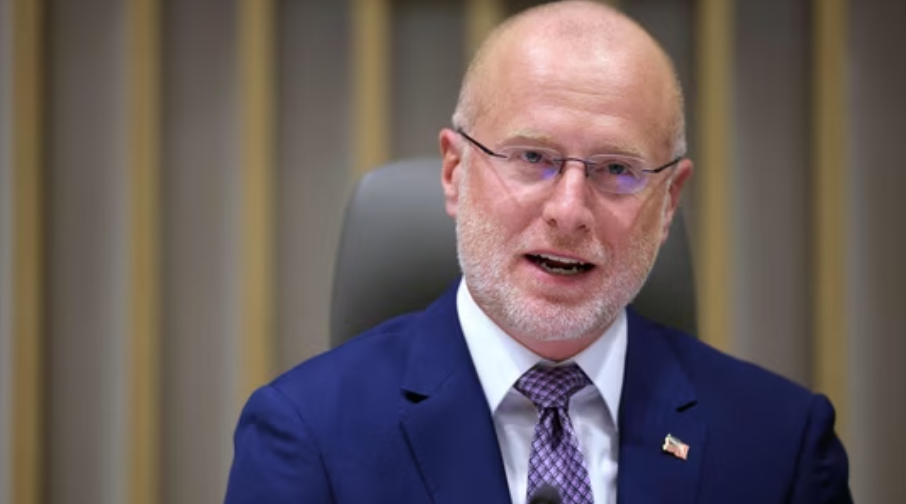
Brendan Carr, the head of the Federal Communications Commission, has issued a sharp warning to US broadcasters, saying their licenses could be revoked if they continue spreading what he described as “fake news” or distorted reporting amid the ongoing Iran conflict.
Carr, who serves as the communications licensing chief under the administration of Donald Trump, made the remarks on social media on Saturday. He warned that television and radio broadcasters who fail to correct misleading coverage could face serious consequences when their licenses come up for renewal.
“The law is clear,” Carr wrote. “Broadcasters must operate in the public interest, and they will lose their licenses if they do not.” His message suggested that stations accused of spreading misinformation still have a chance to amend their practices before the regulatory review process.
The statement quickly sparked political backlash in Washington. Democratic Senator Elizabeth Warren condemned Carr’s remarks, accusing the administration of attempting to intimidate the media. She described the warning as an attack on free speech and argued that threatening broadcasters over their reporting resembled tactics used in authoritarian systems.
The FCC regulates the United States’ electromagnetic spectrum, which includes broadcast television, radio, satellite communications, and various wireless services. The authority for this oversight stems from the Communications Act of 1934, which requires licensed broadcasters to serve the public interest while using public airwaves.
Carr’s warning comes amid escalating tensions between the White House and major American news outlets over their coverage of the war involving Iran. President Trump has repeatedly accused mainstream media organizations of misrepresenting events and undermining US interests during the conflict.
In a post on the social media platform Truth Social, Trump criticized reports about a military incident involving tanker aircraft allegedly destroyed at an airport in Saudi Arabia. The president singled out publications such as The New York Times and The Wall Street Journal, accusing them of publishing “misleading” headlines.
Trump claimed that such reporting falsely portrayed the situation on the ground and suggested that certain media outlets were deliberately damaging the United States’ war effort. “They actually want us to lose the war,” the president wrote, adding that the reports were “the exact opposite of the actual facts.”
The dispute highlights a broader debate within the United States about media freedom and the role of journalism during wartime.
At the same time, public support for the military campaign in Iran appears to be limited. A recent survey by CNN found that about 59 percent of Americans oppose the war. Support for military action ranges between 27 percent and 38 percent, significantly lower than the backing seen during earlier US interventions.
For comparison, the war in Afghanistan following the September 11 attacks enjoyed public support levels of up to 92 percent in its early stages. The Gulf War of 1991 received roughly 80 percent backing, while the Iraq War in 2003 had around 70 percent support. Even the intervention in Libya in 2011 drew higher approval ratings at about 47 percent.
Despite the lower nationwide approval, Republican voters remain largely supportive of the administration’s stance, with roughly 76 percent backing the military action.
Carr’s warning and the political response to it underscore the growing tensions between government authorities and the media as the Iran conflict continues to dominate global headlines.



 English
 Gujarati
 Hindi
Hindi Kannada
 Malayalam
 Marathi
 Punjabi
 Tamil
Tamil Telugu