


 India
India

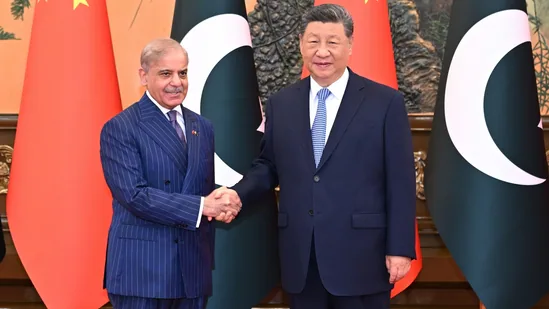
India has issued a strong rebuttal to references made by Pakistan and China on Jammu and Kashmir in their latest joint statement, firmly reiterating that the Union Territories of Jammu & Kashmir and Ladakh are integral and inalienable parts of India. The sharp response came after the Pakistan-China joint declaration, released following Prime Minister Shehbaz Sharif’s visit to Beijing, referred to developments in Jammu and Kashmir and mentioned “trans-boundary water resources cooperation.”
Reacting to the statement, the Ministry of External Affairs (MEA) made it clear that India’s stand on Jammu and Kashmir remains unchanged and non-negotiable. MEA spokesperson Randhir Jaiswal said that Jammu & Kashmir and Ladakh “have been, are and will always remain integral and inalienable parts of India,” adding that no other country has any locus standi to comment on the matter.
India also renewed its opposition to the China-Pakistan Economic Corridor (CPEC), a flagship infrastructure project under China’s Belt and Road Initiative, pointing out that several parts of the corridor pass through territory that India claims as its own. New Delhi described any attempt to legitimise or reinforce Pakistan’s control over those areas as a direct violation of India’s sovereignty and territorial integrity.
The MEA further objected to references in the joint statement regarding “trans-boundary water resources cooperation” between China and Pakistan. India asserted that since the two countries do not share a boundary in the concerned region, the basis for such cooperation does not exist. New Delhi also reiterated that it has never recognised the 1963 boundary agreement between Pakistan and China, under which Pakistan ceded territory in the Shaksgam Valley to Beijing.
The Pakistan-China joint statement, issued at the conclusion of Sharif’s visit to China from May 23 to 26, highlighted deepening strategic cooperation between the two countries. During the visit, Sharif held talks with Chinese President Xi Jinping and Premier Li Qiang, with both sides describing their relationship as an “All-Weather Strategic Cooperative Partnership.”
In the statement, Pakistan briefed China on the latest developments in Jammu and Kashmir, following which Beijing said the issue should be resolved in accordance with the UN Charter. The statement also expressed readiness to pursue “trans-boundary water resources cooperation,” though it did not specify the scope or nature of such collaboration.
India views these references as a continuation of China’s support for Pakistan on sensitive regional issues, particularly Kashmir. Analysts believe Beijing’s inclusion of Kashmir and water cooperation language in the statement reflects its strategic effort to reassure Islamabad while preserving its geopolitical interests in the region, especially around the China-Pakistan Economic Corridor and Gwadar.

New Delhi’s latest response signals that India remains firmly opposed to any external commentary on Kashmir and any projects or agreements that it believes infringe upon its territorial claims.



 English
 Gujarati
 Hindi
Hindi Kannada
 Malayalam
 Marathi
 Punjabi
 Tamil
Tamil Telugu