

 India
India

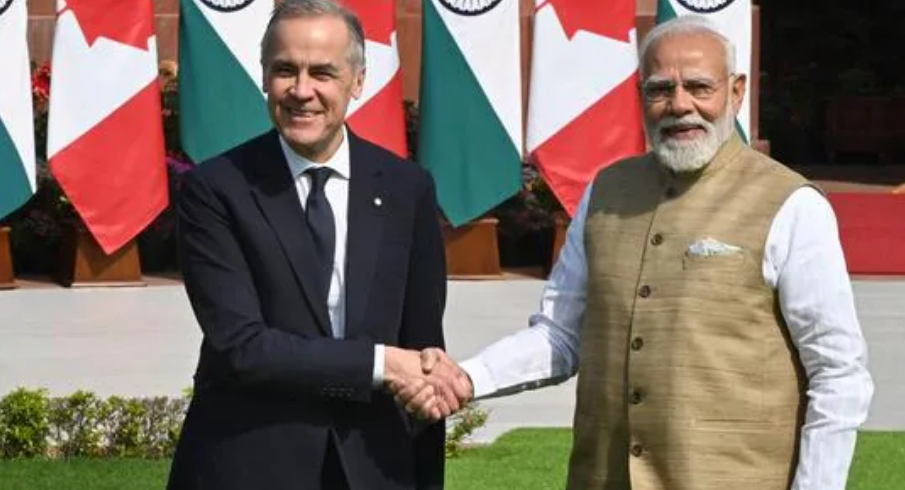
India and Canada took a major step toward strengthening their bilateral partnership on Monday as Prime Minister Narendra Modi and his Canadian counterpart, Mark Carney, finalised key agreements on trade, energy, and defence cooperation. Carney’s visit, the first by a Canadian prime minister to India in eight years, aims to build on the gradual normalisation of ties following the diplomatic crisis of 2023.
During a joint meeting at Hyderabad House in New Delhi, the two leaders signed a memorandum of understanding (MoU) on the mining and processing of critical minerals and concluded a $2.6-billion deal between India’s Department of Atomic Energy and Canadian uranium company Cameco for the supply of 22 million pounds of uranium ore from 2027 to 2035. Both leaders reaffirmed their commitment to increasing bilateral trade and finalising a Comprehensive Economic Partnership Agreement (CEPA) within the year. Modi highlighted that the goal is to reach $50 billion in trade by 2030, emphasising that unlocking the full potential of economic cooperation remains a top priority.
Carney stressed the importance of stronger trade and defence collaboration in a world undergoing “profound transformation,” noting that traditional certainties in diplomacy, finance, and security have been overturned. He described the India-Canada partnership as a strategic collaboration of “middle powers” charting their own course for the future, and outlined plans to expand cooperation in critical minerals, energy security, and technology ecosystems.
The visit also marked the launch of the India-Canada Defence Dialogue, with both sides agreeing to deepen defence cooperation through maritime collaboration in the Indo-Pacific, military exchanges, and support for domestic defence industries. The two leaders discussed small modular reactors, advanced conventional reactors, and initiatives for renewable energy, including Canada’s participation in the International Solar Alliance and the Global Biofuel Alliance. A bilateral Renewable Energy and Storage Summit is planned later this year.
People-to-people ties featured prominently in the discussions. Carney highlighted the nearly 2 million-strong Indian diaspora in Canada, including 400,000 Indian students, while Modi announced new university partnerships in AI, healthcare, agriculture, and innovation. Canadian universities are set to open campuses in India, while a trilateral MoU with Australia will focus on technology and innovation cooperation, including the establishment of a pulse protein centre of excellence to strengthen food processing and nutrition systems.
Overall, Carney’s visit signalled a significant reset in India-Canada relations, turning a period of mistrust into a roadmap for expanded trade, energy collaboration, technological innovation, and defence cooperation. The two nations concluded 24 MoUs covering sectors from education to renewable energy, signalling a comprehensive approach to future engagement.



 English
 Gujarati
 Hindi
Hindi Kannada
 Malayalam
 Marathi
 Punjabi
 Tamil
Tamil Telugu