





 India
India

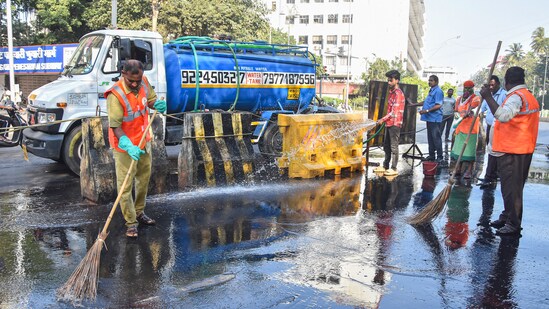
The Bombay High Court on Friday took a firm stand on Mumbai’s deteriorating air quality, directing authorities to enforce strict compliance of pollution-control measures at construction sites and forming an independent committee to monitor violations. The order comes amid repeated complaints and petitions about the city’s worsening Air Quality Index (AQI), which residents and experts say has followed a troubling upward trend since 2023.
A division bench of Chief Justice Shree Chandrashekhar and Justice Gautam Ankhad set up a five-member committee to carry out on-ground inspections. The panel will include representatives from the Brihanmumbai Municipal Corporation (BMC), the Maharashtra Pollution Control Board (MPCB), and the state public health department. Their mandate is to assess whether builders and contractors are following dust-mitigation guidelines such as water sprinkling, barricading construction zones, installing CCTV cameras, and using sensor-based air pollution monitors.
Observing that improving air quality would require consistent, long-term efforts, the court noted that Mumbai still has an opportunity to avoid the scale of pollution seen in Delhi. “This will take some time. Delhi has been struggling for more than 15 years now. Mumbai, in fact, has some benefits. In Mumbai, it can be done,” Chief Justice Chandrashekhar remarked. The bench stressed that while vehicular emissions remain a challenge, dust from construction sites is a problem that can be controlled immediately if the rules are followed.
During the hearing, senior counsel Darius Khambata, appointed to assist the court, pointed out that several guidelines issued in 2024 for construction management were either inconsistently applied or ignored altogether. He highlighted gaps such as irregular use of water sprinklers, poorly maintained dust barriers, and lack of real-time monitoring.
The court directed the BMC and MPCB to provide a comprehensive report by December 15, outlining the steps taken over the past year to curb pollution and enforce compliance among developers. The bench also called for complete transparency in the civic body’s oversight system, including the functioning of special inspection squads and the status of high-resolution CCTV and sensor installations at major construction sites.
Emphasizing urgent intervention, the judges said, “Let us ensure that construction sites and dust pollution are tackled. It can be done immediately in one to two weeks. That would be some effective measures.”
With the city’s winter months typically worsening air quality, the High Court’s directive pushes local authorities to treat construction-related pollution as a priority and implement corrective measures without delay.




 English
 Gujarati
 Hindi
Hindi Kannada
 Malayalam
 Marathi
 Punjabi
 Tamil
Tamil Telugu