

 India
India

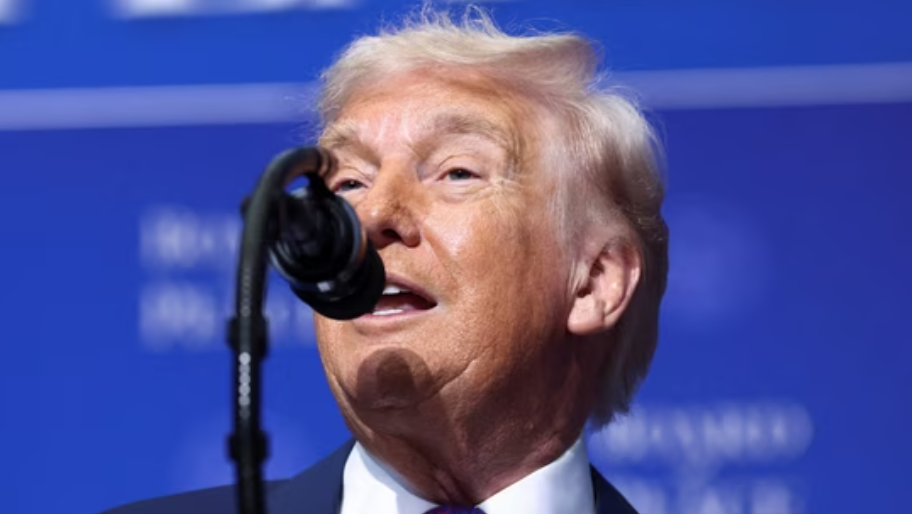
US President Donald Trump has taken a series of shifting positions on the crisis surrounding the Strait of Hormuz during the ongoing conflict involving the United States, Israel, and Iran. His evolving statements on the strategic waterway have highlighted a growing disconnect between bold public claims and the complicated military and economic realities unfolding in the Gulf region.
The tension escalated after Trump announced “Operation Epic Fury” on his social media platform, Truth Social, on February 28. At the time, he described the campaign as swift and decisive. However, more than two weeks later, the Strait of Hormuz — a narrow maritime corridor through which nearly 20 percent of the world’s oil supply normally passes — remains effectively closed to ships linked to the United States and Israel.
In the opening days of the war, Trump made strong claims about the damage inflicted on Iran’s naval forces. He wrote that US forces had destroyed and sunk nine Iranian naval vessels, adding sarcastically that “other than that, their navy is doing very well.” The president also repeated his demand for Iran’s “unconditional surrender,” echoing a similar demand he made during the brief conflict between the two countries in 2025.
Iran responded sharply. President Masoud Pezeshkian rejected the demand and told the United States to “take their unconditional surrender demand to their grave.” Soon after, Iranian forces launched strikes on American military bases across the Persian Gulf region, expanding the conflict’s geographic scope and raising fears among Gulf states such as the UAE and Saudi Arabia.
Despite Trump’s claims that Iran’s military had been “completely wiped out,” the situation on the ground appeared far more complicated. The conflict has largely remained limited to airstrikes, but Iranian drones, missiles, and naval tactics have continued to challenge US and Israeli forces.
The Strait of Hormuz quickly became the central flashpoint. Although Iran said it had not officially closed the waterway, shipping companies began avoiding the route amid fears of attacks. The strait is only about 33 kilometers wide at its narrowest point and serves as a vital gateway linking the Persian Gulf to the Gulf of Oman and the Arabian Sea. Because millions of barrels of oil and significant volumes of natural gas pass through the channel each day, disruptions there immediately affect global energy markets.
Within days of the conflict, oil prices surged above $100 per barrel, sending shockwaves across global markets from Europe to Asia. The situation exposed the gap between Trump’s claims that the US had the strait under control and the reality that shipping traffic had slowed dramatically.
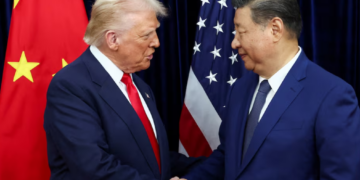
Trump initially insisted that US forces were keeping the waterway open and even described the security of the route as “a gift from the United States to China and other nations that rely heavily on the strait.” At the same time, he warned that if Iran placed mines in the water, the United States would retaliate “twenty times harder.”
Iran’s foreign minister Abbas Araghchi later clarified Tehran’s position, stating that the strait was closed only to American and Israeli-linked vessels, while ships from other countries were still able to pass through. Around the same time, some Indian vessels reportedly continued using the route.
Trump’s messaging then took another turn. In a series of posts, he claimed the United States had destroyed “100 percent of Iran’s military capability.” Yet in the same breath, he acknowledged that Iran could still deploy drones, mines, and short-range missiles — raising questions about the accuracy of his earlier claims.
Soon afterward, the US president called on multiple countries to contribute naval forces to secure the strait. He specifically named China, France, Japan, South Korea, and the United Kingdom, urging them to help protect global oil shipments while the US continued military operations along Iran’s coastline.
The appeal marked a sharp shift from an earlier statement in which Trump suggested that Washington did not need help from allies. In one post, he even mocked the possibility of British support, saying the US had already “won” the conflict and did not require assistance from countries that joined late.
Iran was quick to seize on the contradiction. Araghchi mocked the US call for help, saying Washington was now “begging others, even China, to make Hormuz safe.”
Within the United States, officials have also signaled caution. Energy Secretary Chris Wright indicated that the US was not yet prepared to escort commercial vessels through the strait. Meanwhile, the chairman of the Joint Chiefs of Staff, Dan Caine, described the waterway as a “tactically complex environment” requiring careful planning before large-scale naval operations could be attempted.
The broader goals of the campaign have also remained unclear. Trump and his advisers have cited various reasons for the strikes on Iran, including preventing nuclear escalation, protecting global oil supplies, and promoting political change inside the country. Israeli leaders have framed the conflict in ideological and religious terms as well.
Meanwhile, the war’s domestic political impact is becoming visible in the United States. According to a recent NBC News poll, a majority of American voters — around 54 percent — disapprove of Trump’s handling of the conflict.
With the Strait of Hormuz still at the center of the crisis, the conflict now carries implications far beyond the immediate military confrontation. Energy markets, global shipping routes, and regional stability all remain tied to what happens in the narrow but strategically crucial waterway.



 English
 Gujarati
 Hindi
Hindi Kannada
 Malayalam
 Marathi
 Punjabi
 Tamil
Tamil Telugu