
 India
India

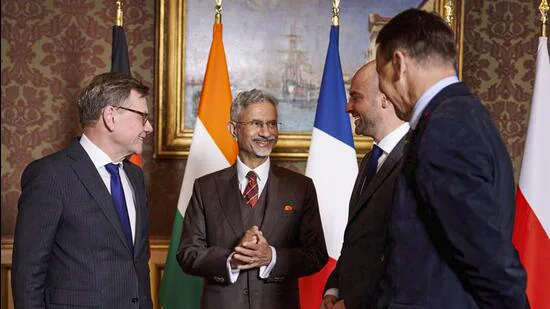
India’s relationship with Europe is poised to expand significantly, with both sides recognising the need for a stronger partnership to help stabilise the global economy and international politics at a time of profound global churn, External Affairs Minister S Jaishankar said on Wednesday. His remarks came during a media interaction in Paris following the first-ever India-Weimar Triangle format meeting involving foreign ministers from France, Germany and Poland.
Jaishankar underlined that India views its engagement with Europe and the European Union (EU) as one of its most promising partnerships, with vast untapped potential. He noted that discussions are already underway on a wide-ranging free trade agreement (FTA) as well as cooperation in key sectors such as advanced technology, semiconductors, railways, defence manufacturing and civil aviation. According to the minister, the depth of the existing relationship provides a strong foundation for further expansion.
“There is already a substantive relationship, but there is much more that can be done,” Jaishankar said, adding that India and Europe must also engage in a broader conversation about the future of the global order. This includes discussions on international norms, economic stability and geopolitical balance at a time when traditional power structures are under strain.
The Weimar Triangle meeting, originally launched in 1991 as a German initiative involving France and Poland, focused on three major areas: strengthening India–EU relations, assessing developments in the Indo-Pacific region, and exchanging perspectives on the ongoing Ukraine conflict. Jaishankar said India’s participation in this format for the first time reflects its growing engagement with Europe and recognition as an important strategic partner.
Highlighting the wider global context, Jaishankar said the Indo-Pacific has been witnessing sustained geopolitical churn, while Europe is facing its own set of strategic challenges. Beyond regional concerns, he added, larger developments are unfolding that could redefine the global order itself, making closer India–Europe coordination increasingly important.
Among upcoming milestones, German Chancellor Friedrich Merz is scheduled to visit India on January 12–13 for talks with Prime Minister Narendra Modi. This will be followed later in the month by a high-profile visit from European Commission President Ursula von der Leyen and European Council President Antonio Costa, who will be the chief guests at India’s Republic Day celebrations on January 26. During this visit, India and the EU are expected to announce the finalisation of their long-negotiated FTA.
In February, French President Emmanuel Macron will also visit India to jointly launch the India–France Year of Innovation with Prime Minister Modi and to participate in the AI Impact Summit, further underlining the momentum in India–Europe relations.


 English
 Gujarati
 Hindi
Hindi Kannada
 Malayalam
 Marathi
 Punjabi
 Tamil
Tamil Telugu